Friday, December 12, 2008
How Rome linked Britain and the Arab world
Tuesday, November 11, 2008
The Great Arab Revolt Project
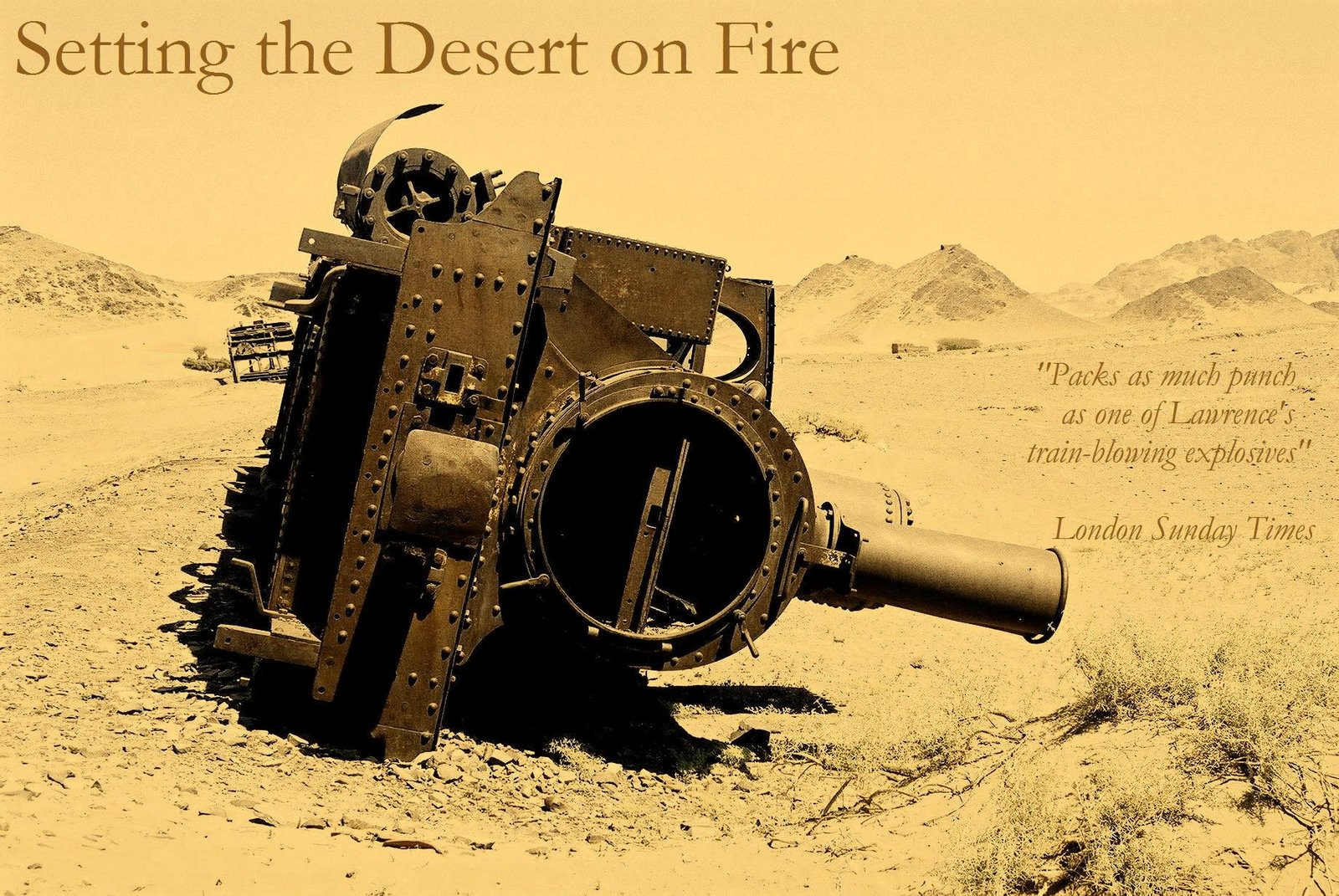
The Great Arab Revolt Project have spent two seasons digging in southern Jordan. They are about to return for a third, excavating at several Hijaz Railway stations for evidence that will give historians a much better idea of what life was like for the Ottoman soldiers guarding the track, and the guerrilla raids that targeted them.
The archaeologists will be blogging about what they find here and maintain a useful website here.
Sunday, September 28, 2008
A shatter'd visage
The fallen head of a statue on Nemrut Dagi, 2150m, south-east Turkey
I met a traveller from an antique land
Thursday, September 11, 2008
Where does the title come from?
Anonymous, in a generous comment yesterday, asks where the title Setting the Desert on Fire comes from. It is taken from page 67 of Seven Pillars of Wisdom (1935 edition). Here is the full quote in context below:
"The Sherif's rebellion had been unsatisfactory for the last few months (standing still, which, with an irregular war, was the prelude to disaster), and my suspicion was that its lack was leadership: notintellect, nor judgement, nor political wisdom, but the flame ofenthusiasm that would set the desert on fire."
Thursday, August 28, 2008
Limited powers
This article, in this morning's Financial Times, caught my eye. It details the efforts of the latest governor of Helmand province, Gulab Mangal, to root out endemic corruption. Mangal, reports the writer, dresses up in disguise and goes out on his weekends looking for policemen seeking bribes. "If they are junior, I sack them on the spot," he is quoted as saying, proudly. Which begs a question - what if they are senior?
To be fair to Mangal, however, the article goes on to suggest that he is trying to break up the local opium trade which, UN figures published earlier this week showed, grew to new record levels in this year's springtime harvest. The UN focused on the fact that overall production in Afghanistan was down, but a drought appears significantly responsible for the fall.
Saturday, August 09, 2008
Golda Meir: the Iron Lady of the Middle East
Tomorrow's Sunday Times runs my review of Elinor Burkett's new biography of the Israeli prime minister, Golda Meir. Here it is.
Tuesday, August 05, 2008
What's going on in Syria?
It's been six years since I went to Syria, so I am not well qualified to talk with insight on the goings-on inside that state. But a report in this morning's Times that a senior Syrian general with links to Hizbollah was shot dead in the port of Tartous last Friday caught my eye. The Times has followed up the story today, quoting an analyst who says that the dead man, Mohammed Suleiman, was the liaison officer between the Syrian regime and the Lebanese political party/terror group/state within a state.* Interestingly, according to Haaretz, Syria's state-controlled media did not report the killing which, presumably, they might have done if they suspected a foreign hand at work.
Syria is being pulled in two different directions. The French, and quietly the British, have been making overtures to the British-educated President Assad (whose wife was brought up in Acton, west London), hoping to separate him from the Iranians. Syria has started talking to Israel, using Turkey as a mediator. On the other hand the President is surrounded by an older generation he inherited from his father, Hafiz, who built close ties with Iran in order to weaken neighbouring Iraq. Whether or not to maintain those ties is now the question. Assad appears to be trying to bridge the gap, saying in the Syrian newspaper Tishreen yesterday that on his trip to Teheran this past weekend he had not been acting as a go-between the West and President Ahmadinejad. On his visit he also met the Ayatollah, drawing attention to his own connection, as an Alawite, to the Shia branch of Islam. He is clearly anxious not to be seen as a puppet of the west.
The Times suggests that the assassination of Suleiman (who, judging by his home-town, is likely also to be an Alawite) is linked to internal tensions over tactics. The absence of comment on the murder in the Syrian press and my own, slightly unsettling, experience of meeting one or two the old guard six years ago make that sound eminently plausible.
* Delete as preferred
Thursday, July 31, 2008
Speaking engagements
Hear me speak about TE Lawrence and his impact:
28 September 2008 to the TE Lawrence Society Symposium, at St John's College Oxford.
27 January 2009 to history students taking the TE Lawrence/Gertrude Bell Special Subject at the University of Cambridge.
11 February 2009, to the Barnes Literary Society.
7 September 2009, at the Making of the Modern Middle East conference, at Christ Church, Oxford.
Wednesday, July 16, 2008
DFID in Afghanistan
I've touched before on the UK Department for International Development's role in Afghanistan. Yesterday's Times ran an interesting article by Anthony Loyd on Britain's aid effort to date in Helmand, southern Afghanistan. Much of the aid Britain has squirted at the Afghans has gone, in Loyd's words, in "bungs, bribes and embezzlement". Given these inescapable facts of Afghan life, Britain's strategy of providing the security to enable the Afghans to resume business on their own terms, seems a better use of money.
Tuesday, July 15, 2008
American support for Israeli policy
Last year John Mearsheimer and Stephen Walt caused controversy with the publication of their book, The Israel Lobby and US Foreign Policy. They argued that groups like the American Israel Public Affairs Committee (AIPAC) have hijacked the foreign policy of the United States to the detriment of Americans' best interests, and included a lengthy study of US support for Israel's attempt to defeat Hezbollah in Lebanon in 2006 to advance their case.
Certainly, if you visit southern Lebanon today - driving past the billboards of bearded Iranian ayatollahs and soft-focus portraits of youthful 'martyrs' attached to street lamps - you will probably agree that Israel's invasion of the area two years ago has had the opposite effect to that intended. The roads have been patched up, farms repaired, and life has returned to normal. Far from being weaker, Hezbollah, which fixed the damage, is stronger than ever.
I have no doubt that Israel runs an impressive lobbying operation - I once benefited from a trip funded by the Israeli foreign office where I was able to meet many key Israeli politicians - but the question on why such lobbying strikes a chord, especially in the US is an interesting one. This month's Foreign Affairs contains a thoughtful article by Walter Russell Mead on the ideological origins and evolution of American support for an independent Jewish state, which is well worth reading in full. It starts with a striking quote from founding father John Adams, who hoped that "Once restored to an independent government and no longer persecuted they [the Jews] would soon wear away some of the asperities and peculiarities of their character and possibly in time become liberal Unitarian Christians".
The article is a gentle rebuttal of Mearsheimer and Walt's thesis, arguing that though liberal and conservative Americans have been sympathetic to Israel for completely different social and religious reasons, the combined weight of their votea has underpinned the benevolent US policy towards the state of Israel. He concludes that "In the future, as in the past, US policy toward the Middle East will, for better or worse, continue to be shaped primarily by the will of the American majority, not the machinations of any minority, however wealthy or engaged in the political process some of its members may be."
Maybe. George Crile's Charlie Wilson's War gives a vivid practical illustration of how baser economic considerations trump ideology in such democratic calculations. Crile describes how the Texan Congressman Wilson's enthusiasm for various foreign regimes was shaped by their decisions over arms procurement that could impact jobs on the General Dynamics plant in Texas that manufactured F-16 fighter jets. Israel was a notable purchaser of these. Mearsheimer and Walt explain the complex financial arrangements by which the United States supports Israel financially and in kind, so that US aid to Israel ultimately ends up keeping US workers in the defence industry in jobs. Mead's article does not touch on this, and how it might affect the US democratic process.
Tuesday, July 01, 2008
National Army Museum, Chelsea
I'm speaking at the National Army Museum in Chelsea at 12.30pm on Thursday.
More details can be found here.
Monday, June 16, 2008
Thursday, May 22, 2008
Key dates in the formation of the modern Middle East
A correspondent gets in touch to ask if I can supply "a chronological listing of events that resulted in the present disposition of territory" in the Middle East.
This is a framework which I needed to do in connection for my next book (on which more in due course). So I sketched out what I think are the key dates.
- 1915 August – British begin secret correspondence with Sharif Husein of Mecca, offering him large, vague empire encompassing Arabia.
- 1915 November – British begin secret negotiations with French for division of Middle East between them.
- 1916 May – Sykes-Picot agreement divides Middle East between France (northern part) and Britain (southern part).
- 1916 June – Arab revolt breaks out in Mecca: by the war’s end the Arabs, under Husein’s son Feisal, would take control of Damascus, a thousand miles to the north.
- 1917 April – Britain invades Palestine
- 1917 November – Britain issues Balfour Declaration offering sympathy with Zionist aspirations for a national home in Palestine
- 1918 October – War in Middle East ends: British troops occupy Palestine, Syria, and, after a post-armistice dash north, all of Iraq.
- 1918 December – Lloyd George and Clemenceau secretly agree Britain should have Palestine and Iraq.
- 1919 summer – Paris peace conference fails to resolve Middle Eastern matters, amid acrimony.
- 1919 November – Britain pulls troops out of Syria, leaving French in charge of coastal area and Arabs under Feisal in charge of inland towns.
- 1920 April – Allies finally agree on allocation of mandates at conference in San Remo, Italy. France to have Syria, Britain to have Iraq and Palestine. The borders are as yet undefined, and their definition would be a source of some friction in the years ahead.
- 1920 July – Britain transfers Palestine from military to civil control. It would rule Palestine until May 1948, trying and failing to keep both Arabs and Jews satisfied.
- 1920 July – Armed with the mandate for Syria, France issues an ultimatum to Feisal and shortly afterwards, throws him out of inland Syria. France ruled Syria until 1946.
- 1920 August – Allies force Treaty of Sèvres on Turkey. This confirms San Remo, and also recognises the Hijaz (western Arabia) and Armenia (eastern Anatolia). Other parts of the former Ottoman Empire are parcelled out between Italy and Greece. The treaty is wrecked by the Turkish nationalists, who fight to take control of Anatolia, and by the refusal of the United States to take on the mandate for Armenia.
- 1920 September – France creates State of Greater Lebanon. Lebanese Republic created on 1 September 1926. Lebanon became independent in November 1943 following a political crisis created by the Free French decision to kidnap the President and Prime Minister, whom they were forced by the British to release. French troops leave in 1946.
- 1921 March – Churchill offers Transjordan to Feisal’s older brother, Abdullah as a temporary arrangement. In September 1922 the League of Nations approves Britain’s request to administer Palestine and Transjordan separately. Britain recognises Transjordan as a state in 1923, and as a kingdom in March 1946. Abdullah was recognised as King soon after.
- 1921 August – British crown Feisal king of Iraq to try to appease Arab opinion in the country following the rebellion the previous year. In October 1922, Iraq agrees treaty with Britain formalising their relationship. Iraq became independent in 1932.
- 1924 July – The Treaty of Lausanne finally settled the borders of Turkey, in Anatolia and in Europe.
Tuesday, May 13, 2008
Wednesday, April 23, 2008
Aerial reconnaissance in the Arab revolt
Another interesting review, this time on Barnes and Noble's website. It usefully draws attention to a book I had not heard about before: Polly Mohs's Military Intelligence and the Arab Revolt, published by Routledge in October last year.
According to the blurb (from Amazon) Mohs argues that "Modern intelligence techniques such as Sigint, Imint [aerial reconnaissance to you and me] and Humint were incorporated into strategic planning with greater expertise and consistency in Arabia than in any other theatre during the war, and their deployment as tactical support for the Arab forces was decisive."
Although the British overplayed the remoteness of the Hijaz, the jagged desert landscape where the revolt played out, there is no doubt that they had little to go by. A few brave explorers - most famously Richard Burton - had criss-crossed the area on foot before the war. The most recent was a young army officer named AJB Wavell who, like Burton, disguised himself as a Muslim to enter Mecca in 1909. Wavell was killed in East Africa during the First World War, before he might have been called in by the Arab Bureau to offer any assistance. The British were thus bereft of signficant first hand experience of the area. When I was doing my research, I was amused to find, in the corner of one British military map, this caveat: "This map is a collection of sketches by Egyptian pilgrimage officers and members of the Sherif's forces. An attempt has been made to control it by native information, but without success."
Until the advent of Google mapping and Google Earth a couple of years ago, maps of Saudi Arabia remained in short supply, and the one I did purchase before I visited in 2005 had few of the obscure places marked, like Wadi Safra and Hamra (where TE Lawrence first met Feisal), that I was keen to go and see. I found myself relying on copies of the same maps that the British officers had used 90 years before to guide their way.
Shortage breeds ingenuity, and the government in London's reluctance to commit forces, and the vastness of the Hijaz both encouraged the British locally to use aerial reconnaissance to make up by accurate information what they felt the Arabs lacked in numbers, weapons, organisation and tactics. After some delaying a flight was sent to Rabigh on the Arabian coast. Lawrence initially in fact dismissed the value of aerial photography - he probably saw it as a threat to his own ventures into the interior, but those reservations did not last long.
I see that an article I read some time ago, about the work of the Royal Flying Corps in the Arab Revolt, has now been joined by the text and maps from Thomas Henderson's first hand account of operations, which is kept in the Imperial War Museum in London. Both are well worth reading.
The British also successfully intercepted Turkish wireless communications. It was not until someway through my research that I discovered that a phrase dotting British telegrams concerning enemy plans - "from an absolutely reliable source" - was shorthand code for information gained from this traffic.
Anyway, since I did not give much specific thought to the role of intelligence in Setting the Desert on Fire, I am looking forward to reading Polly Mohs's book.
Monday, April 21, 2008
Wednesday, March 12, 2008
"The Sinews of War...
... are infinite money," said Cicero. And time hasn't proved him wrong.
A few weeks ago I came up with a figure of over $2,800 a second for the cost of modern warfare. It was a rough calculation based on data published by the US government on its war expenditure in Iraq to date, divided by the number of days since the US invasion in March 2003. I said it was rough.
A far more sophisticated estimate, including many other costs, can be found in Joseph Stiglitz's and Linda Bilmes's new book The Three Trillion Dollar War. I haven't, and won't have time to read it, so this book review by Sam Leith for the Daily Telegraph is useful.
The sentence that caught my eye was this one:
The operating costs of the war in Iraq are now $12.5 billion a month; which rises to $16 billion if you include Afghanistan.
By my arithmetic that works out at $4,760 per second. No wonder then that a committee of British MPs has just announced that it expects the costs of Britain's engagement in Iraq and Afghanistan to double.
The question is how long the British taxpayer will indulge this level of expenditure (and lack of evidence of results) - particularly as the UK's economic prospects worsen.
Monday, March 10, 2008
Iraq today - Lawrence of Arabia's advice from yesterday
On February 18, 1921 T.E. Lawrence started work as an adviser to Winston Churchill, who had just been appointed Britain’s Colonial Secretary. With that job came responsibility for Iraq, the “ungrateful volcano” as Churchill dubbed the country, where the British had finally finished crushing a revolt against their rule.
Churchill knew that Iraq’s people were not the only people who opposed Britain’s three-year-old occupation. British taxpayers were outraged at the cost of Britain’s fractious colony; echoing their temper, the newspapers were demanding the withdrawal of British troops.
A keen student of the public mood, Churchill regarded the situation apprehensively. “I feel some misgivings”, he wrote, “about the political consequence to myself of taking on my shoulders the burden and the odium of the Mesopotamia entanglement.” Those words must reverberate with any of the presidential candidates today for, come January next year, they will find themselves in an uncannily similar position – stuck, as Churchill put it, with a baby, though he was “not the father”.
Churchill hoped that Lawrence could help extricate him from the mess in which he found himself. Lawrence understood insurgencies intimately because he had whipped up one himself, in Arabia against the Turks during the Great War. He knew more than anyone else alive about the Arabs, and guerrilla warfare. And eighty seven years on, his advice remains as resonant as ever.
As Lawrence vividly put it, “To make war on rebellion was messy and slow ... like eating soup with a knife.” So he would recognise the strategy behind the surge. He said that the Turks’ only answer to the uprising he had masterminded would have been to suffocate the area with troops – twenty for every four square miles was the figure he suggested.
Lawrence’s point was that it was beyond the Turks to provide so many men. The same fundamental problem confronts the far mightier United States today. A shortage of troops is why, in the north of Iraq, the US army has come to rely on the support of Sunni “awakening councils”, whose 80,000 vigilantes have dealt the insurgency a bitter blow.
But the Arabic word for awakening, al-nadha, carries important, political, connotations. It is used to refer to the rise of Arab nationalism a century ago and these “concerned citizens” are not simply interested in ending the violence that has blighted their lives. Suspicious of the Shia-dominated government in Baghdad, they want to restore the dominance they have historically enjoyed. Like the Shia, almost all of them say they want Iraq to remain a unitary state – but only so long as it is run by them.
This distrust has ever been the case. As Lawrence put it bluntly, in Iraq the “tribes and towns are irreconcilable.” He therefore advocated splitting the country into two states: a tribal, sparsely populated Sunni north and more urbanised Shia south – areas, he said that “should be kept quite separate”. When it became clear that, because of oil, the British government was set on creating one state that joined the oilfields in the north to the Persian Gulf, Lawrence argued that Iraq would need to be “buttressed by the men and material resources of a great foreign Power.” Then, that power was Britain; today it is America.
“What is going to happen when our influence is removed?” wondered Lawrence’s colleague, Kinahan Cornwallis ,as the British tried to disentangle themselves from Iraq. He predicted: “They will all fly at each other’s throats until someone strong enough to dominate the country emerges or, alternatively, until we have to step in and intervene.”
According to Lawrence the Arabs believed “in persons, not in institutions”. His and Churchill’s solution was to put Feisal, his wartime comrade-in-arms, on the throne in Baghdad in August 1921 – giving what was still fundamentally a British government colony an Arab front-man. Feisal, a Sunni whose claim to be descended from Muhammad was widely recognised, appeared able to bridge the thirteen hundred year old rift between Sunni and Shia. And for a while he did. But even Feisal never really understood the country he had been parachuted in to rule. Shortly before his death in 1933 he described his subjects as “devoid of any patriotic idea …prone to anarchy and perpetually ready to rise against any government whatever.”
Whoever wins in November’s poll faces an awkward choice. For the surge to work more troops are needed, at a time when the American taxpayer may be ill-inclined to finance them; to leave now must make civil war more likely in a country that is fundamentally divided. One thing is certain: he or she will find it difficult to shrug off the “burden and odium” of Iraq.
Thursday, March 06, 2008
The Battlefields Trust
Courtesy of the Battlefields Trust, I'm next speaking in Norwich on 26 April at the Assembly House about my book, and the research and travel that led to it. You can find further details here.
I'm also speaking at:
The National Army Museum, Chelsea - 3 July
The TE Lawrence Society Symposium, Oxford - 28 September
Friday, February 29, 2008
"an early version of Charlie Wilson's War"
The Seattle Times has reviewed Setting the Desert on Fire. You can read it here.