On February 18, 1921 T.E. Lawrence started work as an adviser to Winston Churchill, who had just been appointed Britain’s Colonial Secretary. With that job came responsibility for Iraq, the “ungrateful volcano” as Churchill dubbed the country, where the British had finally finished crushing a revolt against their rule.
Churchill knew that Iraq’s people were not the only people who opposed Britain’s three-year-old occupation. British taxpayers were outraged at the cost of Britain’s fractious colony; echoing their temper, the newspapers were demanding the withdrawal of British troops.
A keen student of the public mood, Churchill regarded the situation apprehensively. “I feel some misgivings”, he wrote, “about the political consequence to myself of taking on my shoulders the burden and the odium of the Mesopotamia entanglement.” Those words must reverberate with any of the presidential candidates today for, come January next year, they will find themselves in an uncannily similar position – stuck, as Churchill put it, with a baby, though he was “not the father”.
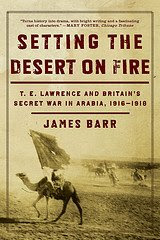
Churchill hoped that Lawrence could help extricate him from the mess in which he found himself. Lawrence understood insurgencies intimately because he had whipped up one himself, in Arabia against the Turks during the Great War. He knew more than anyone else alive about the Arabs, and guerrilla warfare. And eighty seven years on, his advice remains as resonant as ever.
As Lawrence vividly put it, “To make war on rebellion was messy and slow ... like eating soup with a knife.” So he would recognise the strategy behind the surge. He said that the Turks’ only answer to the uprising he had masterminded would have been to suffocate the area with troops – twenty for every four square miles was the figure he suggested.
Lawrence’s point was that it was beyond the Turks to provide so many men. The same fundamental problem confronts the far mightier United States today. A shortage of troops is why, in the north of Iraq, the US army has come to rely on the support of Sunni “awakening councils”, whose 80,000 vigilantes have dealt the insurgency a bitter blow.
But the Arabic word for awakening, al-nadha, carries important, political, connotations. It is used to refer to the rise of Arab nationalism a century ago and these “concerned citizens” are not simply interested in ending the violence that has blighted their lives. Suspicious of the Shia-dominated government in Baghdad, they want to restore the dominance they have historically enjoyed. Like the Shia, almost all of them say they want Iraq to remain a unitary state – but only so long as it is run by them.
This distrust has ever been the case. As Lawrence put it bluntly, in Iraq the “tribes and towns are irreconcilable.” He therefore advocated splitting the country into two states: a tribal, sparsely populated Sunni north and more urbanised Shia south – areas, he said that “should be kept quite separate”. When it became clear that, because of oil, the British government was set on creating one state that joined the oilfields in the north to the Persian Gulf, Lawrence argued that Iraq would need to be “buttressed by the men and material resources of a great foreign Power.” Then, that power was Britain; today it is America.
“What is going to happen when our influence is removed?” wondered Lawrence’s colleague, Kinahan Cornwallis ,as the British tried to disentangle themselves from Iraq. He predicted: “They will all fly at each other’s throats until someone strong enough to dominate the country emerges or, alternatively, until we have to step in and intervene.”
According to Lawrence the Arabs believed “in persons, not in institutions”. His and Churchill’s solution was to put Feisal, his wartime comrade-in-arms, on the throne in Baghdad in August 1921 – giving what was still fundamentally a British government colony an Arab front-man. Feisal, a Sunni whose claim to be descended from Muhammad was widely recognised, appeared able to bridge the thirteen hundred year old rift between Sunni and Shia. And for a while he did. But even Feisal never really understood the country he had been parachuted in to rule. Shortly before his death in 1933 he described his subjects as “devoid of any patriotic idea …prone to anarchy and perpetually ready to rise against any government whatever.”
Whoever wins in November’s poll faces an awkward choice. For the surge to work more troops are needed, at a time when the American taxpayer may be ill-inclined to finance them; to leave now must make civil war more likely in a country that is fundamentally divided. One thing is certain: he or she will find it difficult to shrug off the “burden and odium” of Iraq.
Showing posts with label Anbar Awakening. Show all posts
Showing posts with label Anbar Awakening. Show all posts
Monday, March 10, 2008
Iraq today - Lawrence of Arabia's advice from yesterday


Thursday, January 24, 2008
The latest on Iraq

Something to smile about: a United States soldier plays paper, scissors and stone with an Iraqi boy
[Photo: courtesy of US Department of Defense]
It was interesting to hear the distinctly confident tone of Ambassador David Satterfield when he spoke on Iraq at a meeting organised by the Global Strategy Forum on Monday night. Satterfield advises Condoleezza Rice, and is the State Department's Coordinator for Iraq. He made a compelling case four nights ago that things are getting better - "by any metric", as he put it in his opening remarks. With the surge seemingly responsible for a demonstrable reduction in the violence in Iraq, he said that he was more confident about the future than he had been "ninety - or even twenty - days ago." To be fair to him, he described himself as "cautiously optimistic."
With Satterfield's impressive pitch a memory, re-reading my scribbled notes, it is the problems that stand out however. Although the violence was now dropping, the "laggard", as Satterfield admitted, was the national political process that the surge was designed to give space to breathe.
Although a law designed to rehabilitate some former Baath party officials has now gone through, other legislation setting out how Iraq's oil will be exploited and its proceeds shared out and, secondly, the balance between federal and provincial government has made little progress: and laws on both are vital if Iraq is to become a stable state.
Satterfield was scathing about the Iraqi government at times: it had to govern "more effectively and ... in a national manner", he warned, and he said that it had been "very slow" to respond to the challenges posed by the return of refugees from Syria and Jordan who found that their homes were now occupied by others.
Satterfield described the scale of Iran's diplomatic presence in Iraq as "not appropriate, not helpful", and said Syria was "the primary source of Al Qaeda's suicide bombers". In this respect, this recent report in The Times makes interesting reading.
Questioned about the "Anbar Awakening" - the effort by the Sunnis in Anbar province to root out foreign terrorism, he was categoric that the US government had provided "not a single weapon." "They were very well armed to begin with", he added, drily. He put the number of "concerned citizens" as the vigilantes have been dubbed, at 80,000. However, as this excellent short report from the New York Times shows, the denial, while technically true, is rather academic. Watch the brick of banknotes being passed to one local leader 1 min 37 seconds into the film. Who knows where that cash is going. The film makes it clear that the Sunni awakening poses its own particular problems. As Satterfield observed, "the challenge posed by all the armed elements ... is a considerable one."
Subscribe to:
Posts (Atom)