Last Friday's Times published an interesting list of the 50 key dates of world history by the historian Richard Overy. It's well worth a look: the tight selection inevitably makes it controversial and thought-provoking.
But what's he missed? Money for a start, which could have been added to one of the early Mesopotamian entries. Or accounting, from around the same time. Where's gunpowder, or the flintlock - for their explosive power and ability to change the social order? To be nit-picky I suspect Muhammad's death (and Christ's) were more important than their dates of birth. Muhammad's death sparked the creation of the Caliphate, under which Islam's influence massively expanded. The Black Death of 1348-49 - was responsible for the death of about a third of Asia's and Europe's peoples and spelled the end to feudalism in Europe. Penicillin. The telegraph, radio, television and flight are all absent, despite the impact that they have had on government communications and the speed at which the world moves. Many of the political developments of the early modern era - Hobbes's Leviathan, the US constitution, and the rights founded by the French revolution - all owe themselves to the rediscovery of classical political philosophy which itself resulted from the invention of the printing press and the breaking of the medieval church's restrictive stranglehold on ideas.
Anyway, have a look.
Tuesday, October 30, 2007
Ending the deafening silence


Wednesday, September 19, 2007
Missile defence: will the US go with the Russian suggestion?
Just before I went on holiday to the Caucasus earlier this summer, Russia made an interesting offer to the United States. Faced with the Americans' revived plans to create a missile defence shield with forward radar stations in eastern Europe, at the G8 Summit the Russians suggested that America might use a base in Azerbaijan to site its radar.
I remembered the story when I was travelling through Azerbaijan. At Qabala in the centre of the country, on a hill just south of the Caucasus chain, you can see two enormous concrete rectangular structures which the Russians originally built to warn of an American missile strike against them. Today they monitor Russian space shots. I assumed at the time that this must be the place that the Russians had in mind: and indeed it was - the BBC were there at much the same time that I was. The Azerbaijanis are, by and large, reluctant to talk about politics except obliquely, and my taxi driver (a trained lab technician who could earn more as a cabbie than in a hospital) did not directly answer my question about whether the Azeri press had covered the Russian offer, and if so, what they made of it.
An interesting snippet I have just seen would suggest that the Americans are considering the Russian suggestion, which was presumably made to bring the radar into their sphere of influence.
Azerbaijan is being tugged in different directions by the rival powers. US support for the corrupt Azeri regime is evident everywhere. Public buildings (for example in Sheki) have been renovated with the help of the Department of Defense, and the land border crossing with Georgia is smart, intimidating, and supplied with computers from the US Department of Homeland Security. It will be interesting to see if the United States investigates the option further. Its Missile Defense Agency's website gives nothing away.
Tuesday, August 21, 2007
Flying at each other's throats
I've just come across this interesting quote from Sir Kinahan Cornwallis, a British official who specialised in Middle Eastern matters. Here he is in 1931, commenting on the prospects for Iraq.
"What is going to happen when our influence is removed? My own prediction is that they will all fly at each other's throats and that there will be a bad slump in the administration which will continue until someone strong enough to dominate the country emerges or, alternatively, until we have to step in and intervene." (quoted in Peter Sluglett, Britain in Iraq, London 2007, p.210)
The situation in Iraq is now in flux and there is a sense that in the south, we have reached the finale of the British deployment. British troops in the south are now restricted to Basra Palace and the airport outside the town. Both are dangerous places, because they are attractive targets for regular mortar attacks by local insurgents eager to be able to claim the accolade of having forced the British to withdraw. Mortars are not the only threat. Conditions inside the airport base, where local contractors are also employed, are not deemed safe enough for British civilian officials to travel around without bodyguards. The focus of the British diplomatic effort is, apparently, not in improving relations with the Iraqis, but in persuading the Americans that it is time for the British to leave. Every optimistic British assessment you hear of the local authorities' determination to root out corruption, ability to run the police themselves, and so on, is designed to speed British withdrawal.
Initially proclaimed as a triumph for British "hearts n' minds" over American firepower, the south of Iraq has now become at least as unstable as the regions further north. The killing of the governor of Muthanna province this week is the latest sign that the Shia factions who 'rule' the south of the country have already started, to echo Cornwallis, "to fly at each other's throats". Muthanna had been a relatively quiet backwater, where the British passed control to the Iraqis last summer. Referring to the handover the defence secretary, Des Browne, said: "Today takes them one step nearer to assuming full responsibility for their own security and to building a stable and democratic future for their country." It does not look quite so rosy now. but there is widespread recognition that Britain has neither the forces nor the political will to stop the situation deteriorating further.
The prospect of a British withdrawal from Iraq explains the increasingly vocal American attacks on the British strategy in the south of the country, which are designed to counteract the optimistic British pronouncements that the local authorities are ready to stand on their own two feet, which are the overture to a pull-out. The American strategy to prevent a withdrawal they see as precipitate appears to be try to stir British pride by effectively accusing British troops of cowardice. Outraged British newspaper readers fired up by this slur would, presumably, demand that British troops should stay in place to prove the US wrong.
I wonder whether this rather desperate tactic will work. Surveys recently show that only a small percentage of the British public have friends and family serving in either Iraq or Afghanistan: there is a profound public lack of interest in what is happening in either, and that is clearly having a detrimental effect on British soldiers' morale in both. In this respect, note the successful intervention by the head of the army, General Sir Richard Dannatt this week to pressurise the British Royal Mail postal service into delivering parcels to troops serving in both theatres free of charge. There is little general support for the war, and many people in any case believe that British intervention in the Middle East has made further terror attacks more likely, not the reverse. In other words they may support the professionalism of Britain's armed forces while believing simultaneously that the task they have been given, in the support of the US invasion, was the wrong one. If anything, the Americans' attempt to whip up British outrage is more likely to fuel rising anti-Americanism in Britain.
For Iraqis the sad question is what will fill the vacuum once the British leave. And here it is not difficult to believe that Cornwallis's analysis of the cycle of Iraqi history remains a timeless one.
Tuesday, August 14, 2007
Digging up the recent past
At the start of this year, the Great War Archaeology Group got in touch with me. The GWAG had recently got back from excavating two sites in southern Jordan, places I had also visited during the research I did for Setting the Desert on Fire. I have the greatest respect for them. Whereas I had stopped to take a few photographs and have a look about, they had spent a fortnight under the sun, surveying and digging.
Since for me, archaeology is inextricably connected to the consumption of significant volumes of real ale, their efforts were all the more impressive since they spent their time around the town of Maan, one of the more conservative parts of Jordan, and certainly some distance from the nearest keg of beer. I was delighted to be able to help them tie down the name of the station that they had been excavating on the plain south of Maan, at Wadi Rethem (Rutm), where I had briefly stopped in September 2004.
The discoveries GWAG have made are of real interest in the understanding of the Arab revolt. They have begun to shed some light on the lives of the Turkish soldiers who were stationed along the railway, and provide evidence of the fierce fighting in April 1918 around Maan station.
For a taste of where they were, do visit their website and read their excellent report, which takes a little while to load. They return to Jordan later this year. It will be fascinating to see what more they unearth this time round.
Sunday, August 12, 2007
Bringing back the Caliphate
The BBC is reporting that 100,000 people have attended a rally organised by Hizb ut-Tahrir in Indonesia. Western intelligence and border agencies look as if they have done their best to throw the conference programme into disarray, by preventing several of the speakers from travelling to Jakarta.
Hizb ut-Tahrir - banned in many countries although not in Britain (yet) - campaigns, in incendiary terms, for the restoration of the Islamic caliphate. The caliphs were the Prophet Muhammad's immediate successors; the caliphate originally was the Middle Eastern empire that they went on to conquer in the years after Muhammad's death. With the conquest of that empire by the Mongols in the thirteenth century the caliphate disappeared. The Ottoman sultans appropriated the title from 1416 as they approached the zenith of their power. From then until the collapse of the Ottoman Empire, the Sultan was also the caliph. As the political leader and spokesman of Sunni Muslims worldwide he enjoyed a certain respect from European empires with Muslim colonies, like Britain, for the influence he was believed to wield over their subjects. The Sultan overstepped the mark in 1914, when, egged on by the Germans, he issued a call for jihad against his British, French and Russian enemies. By the time the war had ended Britain in particular was anxious for the caliphate to be wound up. By then and since, the caliphate had become firmly associated with the threat of jihad.
In fact it was the Turkish nationalists who dealt the caliphate its coup de grace. Initially they separated it from the Ottoman sultanate before finally scrapping it in 1924. The last caliph, a dignified and well-educated man named Abdul Mejid, who was a brilliant linguist and a painter, was escorted from Istanbul with two of his wives to the Greek border, from where, with only a small amount of money and "a number of jewels" he crossed Europe by the Orient Express. Photographs taken a few days later show him, dressed in a suit and fez, disconsolately taking the air in a resort on the edge of Lake Geneva. As far as the European powers were concerned, his role was, by the time of his deposition, reassuringly symbolic. As the London Times observed, by then he "had no power, even in spiritual matters; he could not issue decrees, and he was not permitted to exercise any form of patronage." He died in Paris, just as the city was being liberated in 1944.
In centuries past the caliphs took on the mantle of the Prophet. The Times, in its leader on the day after the caliph had been dismissed, wondered what had happened to that green garment. It reappeared in Kandahar in 1996, when the Taliban leader Mullah Omar appeared wearing it in public on a rooftop in the city. By doing so he was making the most open claim possible to be the caliph. A caliphate requires a caliph, and one of the reasons for the suspicion that rightly hangs around Hizb ut-Tahrir is the question of who that caliph would be.
Saturday, August 11, 2007
A brilliant and subtly subversive exhibition
 The Houghton Shahnama, courtesy of the Aga Khan Development Network

Monday, July 30, 2007
Speaking next in September
I'm next speaking to the Saudi British Society at the Middle East Association, 33 Bury Street, London SW1, early in the evening of Tuesday 11th September. If you are interested in coming, further details can be found here.
The date - a coincidence and not deliberate - is certainly a resonant one on which to speak about the Arab revolt, which began 91 years ago this year. It was in his first public announcement after 9/11 that Osama bin Laden claimed that "Our nation has been tasting humiliation and contempt for more than eighty years". Bin Laden shows a considerable awareness of the Arab revolt and its circumstances, and he understands how powerful an abbreviation for betrayal that episode has become across the Muslim world.
Friday, July 27, 2007
"Our man in Pakistan"

Tuesday, July 10, 2007
Back from the Caucasus
 Alaverdi, Northern Armenia
 Thursday, June 21, 2007
Missing Links
If, like me, you don't read or speak Arabic, then this blog, which provides quotes from, and commentary on, the Arabic press is very useful. I added it to my links recently but made no comment.
Monday, June 18, 2007
Out now!

The book featured among the Daily Telegraph's Pick of the Paperbacks on Saturday and has also recently been added to the reading list for Cambridge University's undergraduate history course: TE Lawrence and Gertrude Bell: Britain and the Arabs 1914-1922. See the full reading list here.
Wednesday, June 13, 2007
Advice from the past

See this from Andrew Sullivan. The pdf is the thing to read. I disagree on his money quote; I would go for:
"You aren't going to Iraq to change the Iraqis. Just the opposite. We are fighting this war to preserve the principle of 'live and let live.'"
or maybe:
"Iraq has great military importance for its oil fields, with their pipelines to the Mediterranean Sea."
or perhaps, from the conversion table:
"100 Dinars........................................$402.00"
Today 100 Iraqi dinars is worth less than 8 US cents
And finally, the fact that this copy, in a university library in Dallas, Texas, was last borrowed in 1956.
The pamphlet is full of nuggets. Do read it.
The Sunni-Shia split
The Shia Al Askari mosque in Samarra has been bombed again. It looks like another attempt to deepen the black chasm between Sunni and Shia Muslims in the country even further.
What is the origin of this divide? The answer lies thirteen hundred years ago.
The Prophet Muhammad’s death in 632 AD quickly precipitated a factional dispute over who should follow him as Caliph – a title meaning “the successor”. The murder of the third Caliph, Uthman, opened a schism between the Muslims of Iraq and Syria. When the fourth Caliph, Ali, refused to denounce his predecessor’s killing, a Syrian named Muawiyyah took matters into his own hands and seized the title from Ali; by doing so Muawiyyah became the fifth Caliph; Ali was subsequently murdered.
Ali’s hard-line followers were shocked by their leader’s murder and the speed with which his son Hasan hurried to reach agreement with Muawiyyah. They turned to Ali’s second son, Husein, to front their cause, calling themselves the Shia – short for Shia’t Ali, or the followers of Ali. At Kerbela, southwest of Baghdad, in 681 they were surrounded and massacred by an army loyal to Muawiyyah’s son Yazid, who had by now inherited his father’s mantle.
Thirteen centuries on, processions of Shia flagellants still gorily commemorate the anniversary of Husein’s death. After Mecca and Medina the Iraqi cities of Najaf, where Ali is buried, and Kerbela, where his son Husein met his fate, are the holiest Shia sites in the world. The Shia remain outnumbered by the Sunnis by more than two to one today. The split has its origins in what is now Iraq.
The absence of Alan Johnston
The kidnap of BBC reporter Alan Johnston three months ago, has had an appreciable effect on the BBC's coverage of the developing chaos in the Gaza Strip, which has been building for several days. The BBC started reporting the crisis in detail last night, at least twenty-four hours after most of the events they were describing had happened. There has been a wave of appalling tit-for-tat killings. A commentator on the BBC's excellent World Tonight radio news last night (what a contrast in the amount of information you get compared to the simultaneous television news, where it's always "Back to you Huw") did not believe that this was the beginning of a civil war, but it looks like Fateh will withdraw from the "Unity" government and I fear revenge will take on a momentum of its own, despite the fact that most residents of the Gaza Strip deplore what is going on.
The fighting is fierce enough to prevent the journalists who are still there venturing out into the Gaza Strip but it is hard to believe that, had Mr Johnston not been abducted, the British public would have known rather sooner of the violence that is now drowning the Palestinian state.
Tuesday, June 12, 2007
Witness in Baghdad
The doughty Saad Eskander's diary for May can be read here. Electricity and water shortages in the Iraqi capital have been making life very difficult as the temperature soars and even Eskander's mood seems to darken by the month. If you haven't got time to read the whole, this excerpt gives a flavour of what life is like:
"one or my library workers approached me, asking if I would grant her one month paid leave, before she submitted a memorandum. After I asked her about the reason, she told me that she suffered from some heart problem. She needs to go abroad to have an operation on her heart, as most Iraqi heart surgeons left the country for fear of kidnapping and killing. So, we have not only political, security, electricity, water and economic crises, but also acute medical crisis. We have not enough good medicine, hospitals and experienced doctors. Only the well-off people can go abroad to receive good medical treatment. The poor has always been paying much heavier price then the others, since the outbreak of the Iraq-Iran War in 1980. The night was as hot as the day. The sky was soon clouded. This what made the situation far worse. The temperature exceeded 42 centigrade. We did have national electricity for two days. We could not take frequent showers, as we have been suffering from water shortages for some time now. I was not able to use my generator for more than four hours, as I had little fuel to cool my very hot flat. The prices of fuel have gone up sharply in the black market, as our 'beloved hero' , the Minister of Oil, failed to put an end to the ongoing fuel crisis. Like all Baghdadis, we escaped to the roof, trying to have some fresh air; but there was not any. High temperature and humidity prevented my son and my wife from sleeping. They slept finally at 4.00, after the weather got a bit cooler."
Monday, June 11, 2007
Beyond the world of Big Brother and Paris Hilton
News that the Afghan President, Hamid Karzai, had a close shave when he was rocketed earlier today has finally galvanised me into writing a post I have been planning for ages: a summary of what's been going on in Afghanistan, highlighting the best of the recent press coverage.
The attack on Karzai reflects the country's growing lawlessness, which was highlighted in a report last week in the Independent. It noted a sharp increase in attacks on UN aid trucks and said that the UN's own security assessment showed a severe deterioration in the south of the country. According to the UN, most of the southern provinces of Helmand, Kandahar, Zabul and Uruzgan is regarded as "an extreme risk/hostile environment", when last year, the estimate of these areas was that they were "high risk/volatile".
Despite the worsening violence, at this time of year the southern provinces attract men looking for work in harvesting the annual opium poppy crop. This article explains the dilemma itinerant workers face, while this piece reports collusion between the farmers, Taliban and the local police to share the wealth created by the crop.
In the meantime there is a new genre of article on Afghanistan, familiar to anyone following news coverage in Iraq: the article pointing to Iranian involvement. The BBC currently offers two examples. One report says that Iran is exerting increasing influence in the country ; another reports that a "sophisticated bomb" has been found on the streets of Kabul: interestingly, it does not say when. According to the article, this device's similarity to weapons used in Iraq suggests that there is a technology transfer going on between the two war-torn countries and, the author continues, citing unnamed sources, is evidence of Iranian interference in the country's insurgency. Bombmaking experts - one of whom I met a few weeks ago - say that "shaped charge" bombs are nothing new. They certainly are not proof of Iranian involvement.
An interesting article by a former Indian diplomat in the Asia Times suggested a political decision which may help explain the deterioration in the situation in Afghanistan. MK Bhadrakumar charts the decline to the decision at the end of last year by the Afghan Parliament to grant an amnesty to any Afghan involved in any war crime during the past twenty five years. "At a single stroke", he believes, "the December 31 amnesty move deprived the US of the one weapon that it wielded for blackmailing the 'warlords' into submission - powerful leaders of the Northern Alliance groups, the mujhideen field commanders, and petty local thugs alike. The prospect of a war-crime tribunal was held like a Damocles' sword over any recalcitrant Afghan political personality". The Afghans' decision reflects their own belief that the United States government no longer has the willingness to stay the course in either Iraq or Afghanistan, and once they go, dialogue with the Taliban will be necessary.
The parliamentary decision undermines the apparent progress the British are making in the south of Afghanistan. The British have been trying to provide enough stability to enable the renovation of the hydro-electric powerplant at the Kajaki dam in the north of Helmand province, a project designed to win over local support by restoring electricity, but to do so successfully they have to pacify the area between the dam and the regional capital Lashkar Gah, along the Helmand valley, which forms the main artery of communications and the major opium poppy growing district. Since the Taliban feed off the revenue that the poppy crop generates, the towns along the river, including Gereskh and Sangin have been fiercely fought over.
There has been some evidence that the British are making headway. First came the killing of the one-legged Taliban leader, Mullah Dadullah, a brilliant operation that took advantage of a botched hostage swap in which the Taliban were induced to exchange an Italian journalist they had kidnapped for a number of their captured colleagues. One of these prisoners was Dadullah's brother, who was followed on his release by British special forces to Dadullah himself. The swap, which was heavily criticised, itself sheds light on the new dynamic in Afghanistan identified by Bhadrakumar. Then came came a new British offensive to take control of Sangin, one of the major opium markets in the region. This operation was extensively reported in the Daily Telegraph. The article contains a sentiment echoed in another Times piece today, that the soldiers in Afghanistan feel that their efforts are barely being recognised, beyond sporadic reports of the rising British death toll. "There is a lot of hard graft and sacrifice. It means a lot to the blokes for their exploits to be recognised in a world fixated by Big Brother and Paris Hilton", says a British officer quoted in the Telegraph.
The method and the result of the British offensive are reported by Reuters. Whether the peace will hold remains to be seen.
Friday, June 01, 2007
Hay fever

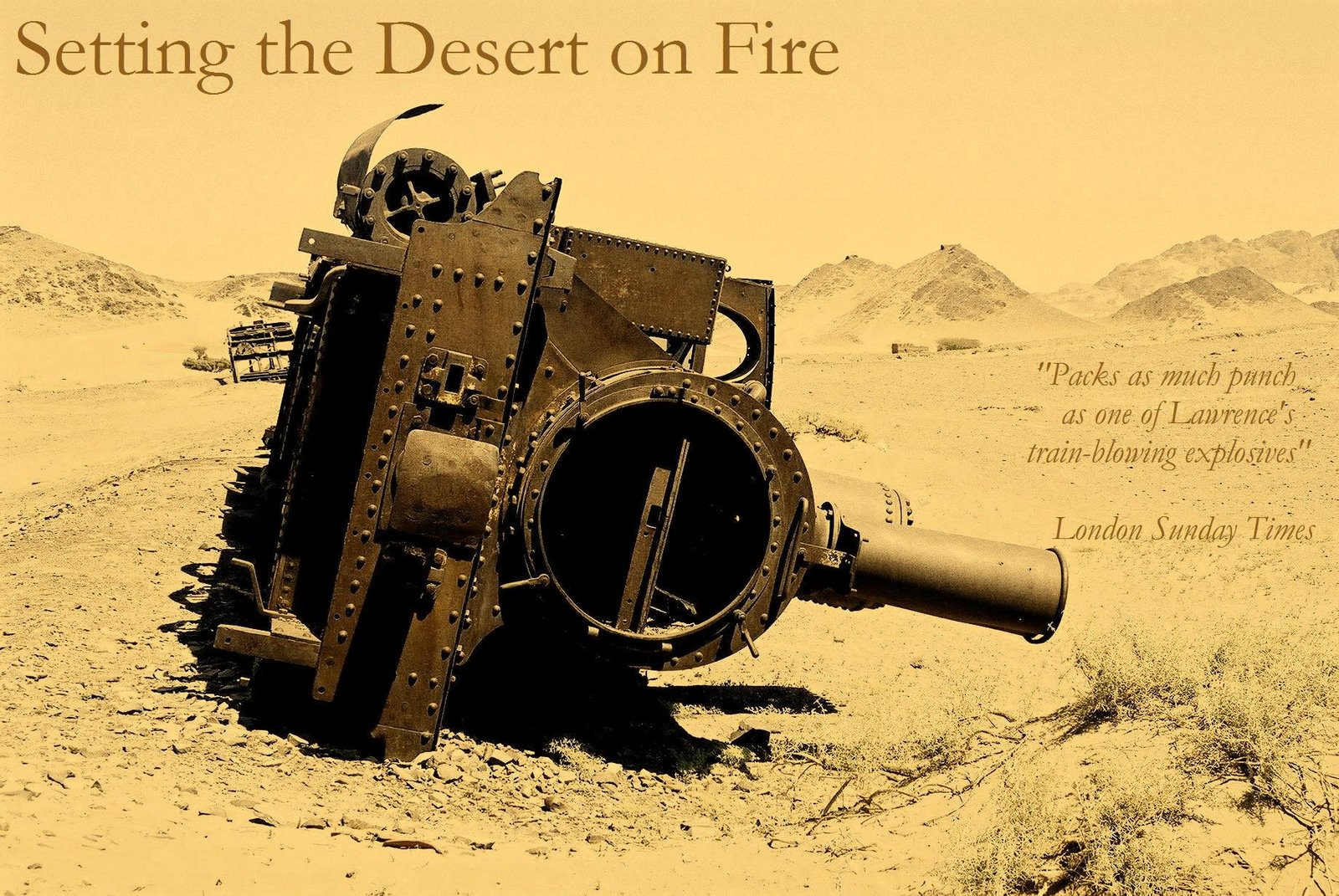
There will be slides - both pictures familiar if you've seen or read my book - and photographs like the one above that I took in the Hijaz mountains on the railway while doing my research in the Middle East. And there will be time for questions and ideas too.
Wednesday, May 30, 2007
Railways, religion and politics

In this project's likely underlying motive, its similarity with the Hijaz railway, 100 years old next year, is uncanny. The Times article says, almost in passing, that "The Iranians, for their part, appear determined to make the Shia shrine easily accessible across the region." And this is surely the crux of the matter. Some of the greatest beneficiaries would, of course, be the sizeable Shia population in Iraq. Like the Hijaz Railway, this new project is profoundly political. It is to win the gratitude of Shias worldwide, and along the way, cause disagreement in Europe on the need for tighter sanctions.
Friday, May 25, 2007
Struggling with the heat?
After a disappearance lasting several months, the Shia cleric Moqtada al-Sadr has magically reappeared in the holy city of Kufah, in Iraq. I've just watched him giving a press conference, half-hidden behind a battery of microphones. You can read the various theories why he has suddenly rematerialised here. Reuters adds that he is trying to reposition himself as a nationalist. In his sermon today he apparently called on his supporters to protect Sunnis and Christians from attack.
What was interesting was the way that Moqtada frequently wiped his face with a handkerchief throughout. His aides claim that he has been in Iraq throughout his absence. But it looked to me as if he was struggling with the heat. My guess, for what it's worth, is that he has just returned from somewhere rather higher and cooler, perhaps in the mountains across the Iranian border.
Thursday, May 24, 2007
Greed and intrigue
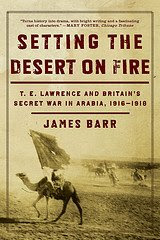
The American edition of Setting the Desert on Fire is now finally coming together. After the publication of the Bloomsbury edition last summer I made further changes to the text to make the story tighter. My publisher WW Norton's Winter and Spring catalogue is now out. "Greed and intrigue", it says, "combine explosively in this gripping tale of how the mercurial Lawrence of Arabia changed the Middle East forever." Publication is set for February next year, and the book will include more of the photographs I took during my research, as well as photographs from the time.
Separately, and halfway round the world, Auckland City Library has nominated Setting the Desert on Fire as one of its "Good Reads" this month.