Britain is sending up to 1,000 more men to Afghanistan, according to various reports this weekend. Sources have denied there is any link between the announcement last week that Britain would begin withdrawing troops from Iraq, but the move is uncannily similar to a plan leaked in September last year. In the newspapers, Robert Fisk argues that Britain has failed to learn from history, citing the destruction of the British army at the Battle of Maiwand in Afghanistan in 1880 as his evidence. But Christina Lamb takes the opposite view.
My view is that, while the British may yet fail in Afghanistan, their only chance of success lies in devoting much greater resources to trying to improve conditions in the country. The effectiveness of aid depends achieving greater security first.
Sunday, February 25, 2007
Will sending more troops to Afghanistan work?


Saturday, February 24, 2007
"A sign of our resolve"
The Daily Telegraph has several reports this morning that add up to a significant amount of sabre-rattling. Israel is apparently requesting permission from the Americans to fly over Iraq so that they can bomb Iran. Another report comes from an American aircraft carrier somewhere in the mouth of the Persian Gulf. This carrier, according to an American diplomat, Mike Gayle, speaking in London last night, is "a sign of our resolve". That was as direct a reply as he would give to the repeated question of whether the United States is willing to go to war with Iran.
The American doctrine of pre-emption has fewer supporters today than it did in 2002. That seems to be the reason why Mr Gayle was keen to suggest that, effectively, Iran is already at war with the United States, citing as evidence a dossier recently published by the US military. This showed photographs of weapons seized in Iraq which the Americans claim are Iranian-made and which they say proves that the Iranian government is behind a wave of devastating attacks on American forces using explosively formed penetrators. But there is a leap in logic there, as one US general has admitted: even if we accept the assumption that the weapons are Iranian-made, proving they have therefore been supplied by the Iranian government is a hard task given the fact that, as any expert on Iran immediately admits, the political structure in Iran is Byzantine in its complexity. And the Americans face considerably greater scepticism than they did five years ago.
The question of whether Iran is supplying weaponry to bog the Americans down in Iraq is misleading and designed to draw attention away from the central question of whether a pre-emptive attack on Iran to halt its nuclear weapons programme is either justified or likely to succeed, by suggesting the United States already has a casus belli for future action.
Friday, February 23, 2007
Advanced geometry
 The ceiling of the mosque in the Amiriya Madrassah, Rada, Yemen
Thursday, February 22, 2007
Was TE Lawrence a Zionist?
That's the claim the historian Sir Martin Gilbert makes in an interview in the Jerusalem Post today. He says that Lawrence had "a sort of contempt for the Arabs" and that he believed that it was "only with a Jewish presence and state would the Arabs ever make anything of themselves."
I wonder. Lawrence's strenuous efforts to champion the Arab cause hardly suggest contempt, and this should not be confused with the increasing exasperation he felt towards them by 1918, which was sparked by the unruly behaviour of the Bedu tribesmen. They were, he admitted at a low point, "the most ghastly material to build into a design."
Lawrence's interest in the Zionists arose from a meeting he had in Cairo in August 1917. There he met Aaron Aaronsohn, a farmer-turned-spy and Zionist who told Lawrence that his plan was for the Jews to buy up the land from Gaza to Haifa and ‘have practical autonomy therein’. On his travels in the region before the war Lawrence had thought that Jewish cultivation of the land would be a good thing. But now his reaction left Aaronsohn with the impression that he was ‘a Prussian anti-Semite talking English’.
By the summer of 1917, a Zionist Commission, headed by Chaim Weizmann, had been allowed to go to Egypt to pave the way for post-war Jewish immigration assuming the British invasion of Palestine was successful. In the background the British Prime Minister, David Lloyd George, believed that the Jews might be able to offer more assistance to the British than the Arabs. Appearing to help the Zionists would also camouflage Lloyd George's rather more imperialist ambitions in the region. But the British in Cairo had at that stage been given no instructions as to how to deal with the Zionist delegation, and this helps explain Lawrence's surprise and response when he heard the Zionists' plans at first hand.
A few weeks later Lawrence wrote to Sir Mark Sykes, the British politician who advised the Cabinet on the Middle East. In this letter (which Sykes never in fact received) Lawrence distinguished sharply between what he called "the Arab Jews" and the "colonist Jews (called Zionists sometimes)". The former spoke Arabic, the latter Yiddish. He asked Sykes: What have you promised the Zionists and what is their programme?’ Was the acquisition of land by the Jews, Lawrence asked, ‘to be by fair purchase or by forced sale and appropriation’? And, given that the Jews rarely employed Arabs on their farms, Lawrence wondered whether ‘the Jews propose the complete expulsion of the Arab peasantry, or their reduction to a day-labourer class’. He predicted trouble if in the future Arab states surrounded a Jewish state built on the lines Aaronsohn had laid out. He foresaw "a situation arising in which the Jewish influence in European finance might not be sufficient to deter the Arab peasants from refusing to quit - or worse!"
Lawrence's wartime ally Feisal initially took a rather more relaxed attitude towards the Zionists. At British instigation he met Weizmann north of Aqaba on 4 June 1918. Lawrence was not present at the meeting. There Feisal said that it was important that the Jews and Arabs cooperated, but he said that he was acting as his father’s agent and was unable to discuss the settlement of Palestine in detail, at least not until Arab affairs were ‘more consolidated’.
Feisal's attitude changed with time. At the Peace Conference in 1919, Lawrence presented a memorandum written by Feisal who was increasingly concerned about the Zionists, who were talking increasingly boldly about their hopes. The two men worked closely together, with Lawrence acting as adviser and interpreter. Of Feisal Lawrence once wrote "I usually like to make up my mind before he does". So it is likely that the memorandum also represented Lawrence's view. "If the views of the radical Zionists ... should prevail," it stated, "the result will be ferment, chronic unrest, and sooner or later civil war in Palestine." The memorandum made the same distinction that Lawrence had in his letter to Sykes: "with the Jews who have been seated for some generations in Palestine our relations are excellent. But the new arrivals exhibit very different qualities from those 'old settlers' as we call them, with whom we have been able to live and even co-operate on friendly terms. For want of a better word I must say that new colonists almost without exception have come in an imperialistic spirit. They say that ... under the new world order we must clear out; and if we are wise we should do so peaceably without making any resistance to what is the fiat of the civilised world."
The similarity of distinction between Lawrence's earlier letter and this memorandum seems to suggest that Lawrence took the view that Jewish immigration, which was the natural consequence of Zionism, would destabilise the region. Certainly he hoped for peaceful relations with the Jews who already lived in Palestine. He even believed that the Arabs would "support as far as they can, Jewish infiltration". But calling him a Zionist seems far-fetched.
Anyway, it will be interesting to see where Gilbert gets this idea from. His book, Churchill and the Jews, comes out in June.
Wednesday, February 21, 2007
Blair's withdrawal leaves Bush exposed
Though it has been broadly welcomed in Britain, Tony Blair's "announcement" today of a reduction in the number of British troops in Iraq is really nothing new. Goverment sources have been promising to withdraw troops for a while. One is left with the suspicion that the timing of the "news" has more to do with camouflaging the latest twist in the "cash for peerages" investigation going on in Britain, as well as preparing the ground for Mr Blair's approaching departure from Number 10. Another factor may be the opinion poll this week which showed that the opposition Conservatives, who broadly supported the war, have extended their lead over the government. Certainly there has been no sea-change on the ground in Iraq to justify the timing of the move. Despite official claims that Operation Sinbad - the effort to clear up sectarianism within the Basra police and military - has been a success, the violence, if anything is worse. And that is reflected in the fact that the withdrawal is actually happening much more slowly than one earlier report anticipated.
The announcement may have served the British Prime Minister nicely but, surprisingly, its timing has exposed President Bush, who has just ordered a surge of troops into Baghdad to try to stop the escalating violence. Bush's critics in the US are now using the clearly different directions of British and American policy to attack the President. The White House must be furious.
Tuesday, February 20, 2007
Monday, February 19, 2007
DFID under fire in Afghanistan
A report in today's Daily Telegraph highlights the ineffectiveness of the aid "effort" in southern Afghanistan so far. Until recently Britain's Department for International Development (DFID) had no representatives at all in Helmand because it was too dangerous and criticism of the department's approach is mounting. The former provincial governor, Mohammed Daoud, is especially scathing. "Their QIP (Quick Impact Projects) I called SIP projects: Slow Impact Projects", the Telegraph quotes him saying. DFID's failure so far is, however, partly because there is no consensus about whether or not to destroy the poppy crop on which many of the local farmers depend, and mainly because there are not enough troops on the ground to create the security needed for aid projects - such as alternatives to opium production - to take root.
The starkest example of this is the fighting over the Kajaki dam, north of the provincial capital, Lashkar Gah. The dam should be able to provide much-needed electricity for the Helmand region, but the barrage needs an extra turbine and the contractors hired to fit it will not start work until the surrounding area is clear of Taliban. A small force of Royal Marines has been trying to drive off the insurgents. Their efforts have been well-reported. But they do not have the numbers to hold the ground they clear. Once they withdraw the Taliban reappear. Until more troops are made available, aid work in the region is doomed to fail.
Thursday, February 15, 2007
The best laid plans...

Saad Eskander's diary
Tuesday, February 13, 2007
A Churchillian dilemma
With the Blair era drawing to a close, attention in Britain is now turning to the way in which his probable successor, Gordon Brown, might define a fresh start. One possibility is that he might order a rapid withdrawal from Iraq. The rumour is persistent because, while he has publicly supported the war, Brown has carefully also managed to sound rather sceptical about it. When asked whether he did support the policy before the last election on BBC Radio 4's Today programme, a millisecond's pause before his answer "...Yes", conveyed the opposite impression: "No."
Winston Churchill would have understood the dilemma well. In 1922 Britain was faced by a resurgent Turkey. Churchill, who had been lumbered with the job of dealing with Iraq, feared that the Turks would invade that country, then under the British mandate. Britain might have to send more troops to fight off an invasion, an outcome he knew would be extremely unpopular.
Churchill wrote to the beleaguered Prime Minister Lloyd George (to whom Blair increasingly bears an uncanny resemblance) on 1 September 1922: "I do not see what political strength there is to face a disaster of any kind and certainly I cannot believe that in any circumstances any large reinforcement would be sent from here or from India. There is scarcely a single newspaper – Tory, Liberal or Labour – which is not consistently hostile to our remaining in this country. The enormous reductions [in the number of troops stationed in Iraq] which have been effected have brought no goodwill, and any alternative Government that might be formed here ... would gain popularity by ordering instant evacuation. Moreover in my heart I do not see what we are getting out of it. Owing to difficulties with America, no progress has been made in developing the oil. Altogether I am getting to the end of my resources." (CHAR 17/27)
The same prospect haunts Mr Brown today.
Monday, February 12, 2007
The Kalashnikov index
 The price of a Kalashnikov in Iraq, 2002-present day
Several references to the rising cost of an AK-47 in Iraq have caught my eye, as well as a mention of the so-called Kalashnikov index: the market rate for one of these weapons. However, no-one in the press seems to have put together the data to show the market trend, so I decided to do a little further research into the prices to produce the chart above.
It lacks sophistication: the bars show the range between the highest and lowest prices I could find quoted in any one year. There is enormous variation between the relatively peaceful Kurdish area in the north, and the Arab south, and significant differences between districts in the capital Baghdad. The genuine Russian-made weapon commands the highest prices; copies, either from Eastern Europe or the workshops on the lawless North-West Frontier in Pakistan are the cheapest. The price has varied from as little as $10 (when weapons were dumped on the market by the defeated Iraqi army) to $800 today.
The greatest variation can be seen in 2006, and this reflects the sharp climb in the value of an AK-47 which took place during the year. The attack on the al-Askari Shia shrine in Samarra in February last year is widely attributed to the sudden jump in the price of guns, as well as bullets, which nearly trebled in price to about 50 US cents apiece.
The Kalashnikov index is effectively a futures market for violence. Rising prices reflect rising expectations of violence in the future and attempts by the Iraqis to protect themselves. Succinct commentary on the market trend is provided by one dealer quoted in the San Francisco Chronicle. "This is not the time to sell guns, only to buy guns", he said.
Sources:
New York Times
Small Arms Survey
San Francisco Chronicle
Friday, February 09, 2007
Poppy update: cultivation up 70% on last year
This is the first report I've seen suggesting that this year's opium poppy crop in Afghanistan may dramatically exceed last year's record yield. I flagged up a report three months ago that the crop might match last year's. The explanation given by the head of Helmand province's agricultural department is refreshingly blunt. "Farmers are not receiving adequate support from the government", he admits, "so they are growing more poppy." He believes that there are 60,000 hectares under cultivation in Helmand, a 70% increase on last year.
This news arrives amid debate over what to do about the town of Musa Qala which, after Sangin, is the region's major opium market. The British withdrew from the town last year following a series of clashes with the Taliban, leaving the local elders to keep the peace. This negotiated solution attracted criticism from the Americans, criticism which has strengthened since the Taliban recently reoccupied the town. The Taliban commander, Mullah Ghafour, was killed shortly afterwards by a NATO airstrike, and some people are now arguing that a fuller offensive designed to drive the Taliban out of the town would also disrupt the harvest and the subsequent sale of the crop.
Wednesday, February 07, 2007
Meeting the Sadr family
With the influence of the Shia Sadr family firmly in the news in Iraq, some letters by Gertrude Bell have caught my eye. In a first she complains that
"It's a problem here how to get into touch with the Shiahs, not the tribal people in the country; we're on intimate terms with all of them; but the grimly devout citizens of the holy towns and more especially the leaders of religious opinion, the mujtahids, who can loose and bind with a word by authority which rests on an intimate acquaintance with accumulated knowledge entirely irrelevent to human affairs and worthless in any branch of human activity. There they sit in an atmosphere which reeks of antiquity and is so thick with the dust of ages that you can't see through it - nor can they."
And so, when an opportunity arose to meet the Sadrs, Bell accepted rapidly. She described them as "bitterly pan-Islamic, anti-British et tout le bataclan [the whole caboodle]".There follows an atmospheric description of her first meeting with the family, in the town of Al Kazimiyah, near Baghdad, in March 1920.
"The upshot was that I went yesterday ...We walked through the narrow crooked streets of Kadhimain [Al Kazimiyah] and stopped before a small dark archway. He led the way along 50 yards of pitch-dark vaulted passage - what was over our heads I can't think - which landed us in the courtyard of the saiyid's house. It was old, at least a hundred years old, with beautiful old lattice work of wood closing the diwan on the upper floor. The rooms all opened onto the court - no windows onto the outer world - and the court was a pool of silence separated from the street by the 50 yards of mysterious masonry under which we had passed.
Saiyid Hasan's son, Saiyid Muhammad, stood on the balcony to welcome us, black robed, black bearded and on his head the huge dark blue turban of the Mujtahid class. Saiyid Hasan sat inside, an imposing, even a formidable figure, with a white beard reaching half way down his chest and a turban a size larger than Saiyid Muhammad's. I sat down beside him on the carpet and after formal greetings he began to talk in the rolling periods of the learned man, the book-language which you never hear on the lips of others. Mujtahids usually have plenty to say - talking is their job; it saves the visitor trouble. We talked of the Sadr family in all its branches, Persian, Syrian and Mesopotamian; and then of books and of the collections of Arabic books in Cairo, London, Paris and Rome - he had all the library catalogues, and then of the climate of Samarra which he explained to me was much better than that of Baghdad because Samarra lies in the third climatic zone of the geographers - I need not say that's pure tosh.
He talked with such vigour that his turban kept slipping foreward onto his eyebrows and he had to push it back impatiently onto the top of his head. And I said to myself "If only that great blue turban of yours would fall off and leave you sitting there with a bald head I should think you just like everyone else." But it didn't and I was acutely conscious of the fact that no woman before me had ever been invited to drink coffee with a mujtahid and listen to his discourse, and really anxious lest I shouldn't make a good impression." [14 March 1920]
Within a few months her perception of the family changed. An uprising erupted in Iraq that severely tested British control. As Bell afterwards admitted, the Sadrs had played a crucial role in the violence.
"The villain of the piece is Saiyid Muhammad Sadr, the son of old Saiyid Hasan Sadr ... a tall black bearded 'alim with a sinister expression. [When Bell first visited in March 1920] Saiyid Muhammad was little more than the son of Saiyid Hasan, but a month later he leapt into an evil prominence as the chief agitator in the distrubances. In those insane days he was treated like a divinity. Shi'ahs kissed the robe of men who had touched his hand. We tried to arrest him early in August and failed. He escaped from Baghdad and moved about the country like a flame of war, rousing the tribes. It was he who called up the Diyalah tribesmen and caused all those tragedies .... His next achievement was on the upper Tigris. In obedience to his preaching the tribes attacked Samarra but were beaten off. He then moved down to Karbala and was the soul of the insurgence on the middle Euphrates. Finally, when the game was up, he fled with other saiyids and tribal shaikhs across the desert to Mecca..." [20 July 1921]
Muhammad Sadr returned to Iraq after the British declared an amnesty as a prelude to parachuting (the Sunni) Feisal in as king. According to Bell, Muhammad Sadr "intended to be second to Faisal, if indeed Faisal were not second to him, but Faisal can't bear him and he finds himself relegated to a position of comparative obscurity, with us, whom he hates, and our friends, whom he hates equally occupying the front of the stage. He has still a certain amount of influence and it's a hand to hand conflict between us and him."
And so began the struggle which persists today.
Tuesday, February 06, 2007
Can democracy solve the growing crisis in the Middle East?
Many people - particularly in America and Israel - don't believe that Syrian overtures for talks are genuine. But amid many reports that huge numbers of Iraqi refugees are causing concerns in Syria and Jordan, President Bashar Assad of Syria's comments in an interview with ABC news are worth noting. It is clear he fears a domino effect, with violence between Sunni and Shia in Iraq overflowing to engulf the wider Middle East. Some signs of this are already showing in northern Yemen, where a renewal in the Shia insurgency there looks like it may not be coincidental.
Assad's other comment, that the American ideal of bringing democracy to Iraq has done precious little good - "What's the benefit of democracy if you're dead?" he asked rhetorically - chimes with a thoughtful piece by former British soldier Zeeshan Hashmi in The Times. Towards the end he suggests: "Stop using the notion of democracy to justify loss of human life; we need to ensure that we create a more stable and less bloody future for coming generations. This is the least we owe to those who have made sacrifices. Political systems and doctrine can not effectively be imported from one region to another facing a different range of problems."
Thursday, February 01, 2007
British Library 0, London Library 1
My hope of looking at some interesting 1920s correspondence in the British Library yesterday was foiled because its staff were on strike. "Librarians on strike", as you probably are thinking, sounds rather stronger than it was. No braziers, yells of "Scab", and only a handful of rather forlorn staff holding limp placards. But it was a right pain.
So I went instead to the London Library in St James's Square. There you pay £180 for a year's membership, but it is possible to borrow books, and you get access to the shelves themselves, where the books are ordered by subject. So although you might be after one particular book, it could be that it's the volumes either side that catch your eye. It is an amazing place, and the fee is worth every penny. And so far, I have never seen the staff go on strike.
It also made me think harder about a piece in the Daily Telegraph by Sam Leith on Monday. Leith commented on the possibility that a funding shortage at the British Library might force it to charge for entry, shorten its opening hours, or reduce its collection. On one point, I agree with Leith. Cutting the collection would be to undermine the library's essential purpose: to hold a copy of every book published in Britain, and more besides. And I'd rather not see the opening hours shortened: for people like me, who want to do research after a day in the office, the library shuts too early already. Which leaves charging. And that, on yesterday's experience, doesn't bother me too much.
The best bit about Leith's piece is his comment that the British Library's "on-site catering, like its wireless internet access" is "extortionately priced and only intermittently satisfactory..." Last time I visited the library I could have sworn that the catering is run by the famous cook, Prue Leith. Who is Sam's aunt.
Tuesday, January 30, 2007
Iraq in fragments
 Iraq in Fragments; Mohammed is bullied by his guardian/boss, Abu Ziad
Thursday, January 25, 2007
Poppy harvest update
Amid the first signs of friction between the United States and the British there's a debate in Afghanistan going on about whether or not to spray the poppy crop which is currently growing in the country, to destroy it. The American government backs spraying. The British - worried about a local backlash - do not. Today Associated Press reports that the new governor of Helmand has ruled it out, though somehow I doubt that his intervention will end the argument. The sense of urgency of these discussions is because the weather conditions have apparently been perfect for opium poppy farming and the harvest is expected to begin early, in March.
In the meantime, the British Medical Association has stepped in, suggesting that Afghan farmers should be licensed to produce the crop, to legalise their way of life and help end a shortage of diamorphine in the National Health Service. Critics of this idea say that the drug smugglers can always offer more for the crop. The other way to deprive the Taliban of this major source of revenue, of course, would be to legalise the drug in Britain. And I look forward to meeting the politician brave enough to advocate that...
Education, education, education
 (Image courtesy Greg Mortenson, Central Asia Institute)
Tuesday, January 23, 2007
The media-savvy Taliban
One of the points Sean Langan made last night in the question and answer session after his film was that the Taliban are becoming increasingly media-savvy. Previously, the Taliban actively avoided publicity and obstructed reporters who wanted to film. Now, both Sean Langan and David Loyn have been able to meet the Taliban.
The Taliban have taken this battle for hearts and minds to a new level with their announcement today that they will spend $1 million building new schools in the south of Afghanistan. Deeply cynical though this announcement is - the Taliban's campaign of terror has been behind the destruction and closure of schools across Afghanistan - it is designed to capitalise on the dissatisfaction the Afghans feel with their government, because of its failure to deliver over the last five years. It will be interesting to see whether the promise is followed up by action. But unless foreign governments can dramatically improve the lives of ordinary people across the country soon, they will quickly lose what little local sympathy they still have.
"Fighting the Taliban"
Last night I went to the Frontline Club to see a screening of Sean Langan's documentary "Fighting the Taliban", which was aired on Channel Four's Dispatches recently. With Channel Four coming in for so much stick at the moment, it's worth pointing out that this was an awesome piece of reporting, much of it punctuated by the snapping of enemy bullets passing within feet of the camera. Sean Langan's friend Toby Young quoted him quoting Churchill in The Spectator recently: "Winston Churchill was right", said Langan over dinner back in Britain, "There is nothing more exhilarating than to be shot at without result." Having survived the ordeal, Langan brought back impressive footage showing the difficulties the British are facing, with enormous courage, in southern Afghanistan at present.
Monday, January 22, 2007
Disappointing
 Fallen columns at Apamea, Syria
Friday, January 19, 2007
Armenian writer murdered
This is a nasty piece of news from Turkey. And it is absurd for the Prime Minister Tayyip Erdogan to say that the murder was a “bullet fired against free speech and democracy” when Mr Dink and many others have been found guilty by the Turkish courts of “insulting Turkishness”. Their “offence” is their refusal to gloss over the Armenian genocide which took place during the First World War following the Sultan’s call for jihad on 14 November 1914.
Interestingly, a Turkish press is interested in publishing my book in Turkish. In it there is a passing reference to the genocide. I shall be watching closely to ensure that it is not edited out of the translation.
The Turks are a proud people but they have to come to terms with the past.
Wednesday, January 17, 2007
Tribes and towns
Due to the wonders of technology I am actually able to write this direct from the Churchill Archive in Cambridge, where I am working today.
Following the revolt in Iraq in 1920, Sir Percy Cox, a popular British officer who had been the chief political officer in Baghdad during the First World War, was brought back to serve as High Commissioner. Coccus, as he was known to the Iraqis, was clearly the linchpin. As one of his colleagues wrote: "the whole apparatus of administration is held together simply by Sir Percy’s personality." The official went on to have a dig at Lawrence, whom, he said thought that it would be possible to unite the tribesmen and the towns. "The former are terrified of an Arab Government as we understand it (the Euphrates tribes hoped for universal lawlessness), and they accept it only because of Sir Percy." Lawrence denied this: "tribes and towns are irreconcilable" he wrote in the margin of the report, pointing to one essential fautline in the Iraqi state today. (Ref: CHAR 17/2/100)
Tuesday, January 16, 2007
Overstretched, over there
Of all the British newspapers, the Glasgow Herald is reporting in greatest detail on Afghanistan at the moment. The reason is that it is a unit based in Scotland, 45 Commando Royal Marines, which is serving in the lawless Helmand province in southern Afghanistan at present.
The Herald reports that the US Defence Secretary Robert Gates asked Tony Blair on Sunday for Britain to send 1,000 more troops to Afghanistan. With the British Army as stretched as it is, such an increase could only come if troops were withdrawn from Iraq, which in fact the Daily Telegraph reported they would be the other day. The development follows the deaths of two British soldiers serving in the region in the last three days.
A unnamed source quoted in the Herald report says that the British contingent needs twice the number of helicopters and three more battalions of troops. The shortage of air transport was brought home in Sean Langan's recent documentary for Channel Four's Dispatches, on operations in the south of the province, where Afghan casualties could not be evacuated because a helicopter had already been diverted to pick up British wounded elsewhere.
Monday, January 15, 2007
Foreign aid - more harmful than good?
I've just seen an interesting piece in yesterday's Observer reporting new research by a group called Tiri. Tiri claims that much of western aid sent to rebuild wartorn countries in fact breeds political instability and violence. The report highlights the situation in Afghanistan, saying that western countries' determination to back Hamid Karzai's government is completely counterproductive, since the Afghan government is widely and correctly perceived by the Afghans to be corrupt, fuelling support for the Taliban.
At a debate organised by Intelligence Squared before Christmas I witnessed a scepticism about benefits of government aid that surprised me, although I tend to share it. Speaking for the motion, that 'foreign aid to poor countries has done more harm than good', were the former Reuters correspondent Aidan Hartley and an American named David Rieff, who I had not heard of before but who presented his case in a wonderfully laconic style. Speaking from his own experience in Kenya, Hartley suggested that aid frequently finds its way into buying more Mercedes for Africa's corrupt rulers. The star against these two was Rory Stewart, who asked the audience to imagine what the world might be like if all aid was stopped altogether. As a piece of oratory, Stewart's speech was the most brilliant. Yet the audience voted narrowly against him.
Sunday, January 14, 2007
Will the surge work?
.jpg) US troops patrolling in Adhamiya, Iraq, December 2006 (Photo: United States DoD)
US troops patrolling in Adhamiya, Iraq, December 2006 (Photo: United States DoD)Friday, January 12, 2007
Sunday Times Oxford Literary Festival
 I'm speaking at the Sunday Times Oxford Literary Festival on 22 March at 2.30pm.
Thursday, January 11, 2007
Can the Shia rule Iraq?
Last night President Bush announced a ‘new strategy’ which will involve sending thousands more US troops whose main task will be to try to stop the violence in Baghdad. But he also seemed to be trying to shift increasing responsibility onto the Iraqi government headed by Prime Minister Nuri al-Maliki.
Suspicions are growing that Mr Maliki’s predominantly Shia government has not been doing enough to govern for all Iraqis – including the Sunni and Kurdish minorities. “Only the Iraqis can end the sectarian violence and secure their people”, Mr Bush pointedly noted last night: “Prime Minister Maliki has pledged that political or sectarian interference will not be tolerated.”
The question of whether a Shia could govern Iraq was one the British faced in 1918. When a local Shia sheikh offered his services as Emir of Mesopotamia, he was turned down on the grounds that “It would alienate Sunni element in Baghdad which accounts for the best educated and most advanced group in Mesopotamia. …It would raise throughout Iraq latent animosity between Shiah and Sunni which every administration must strive to allay.” (The National Archive: FO 141/444/7)
Wednesday, January 10, 2007
The oilfields of Persia and Mesopotamia
I spent yesterday back at the National Archives in London, making the first investigations which may turn into a new book. By far the most interesting document I found was a memorandum written by British Naval Intelligence and entitled “The Oilfields of Persia and Mesopotamia”. It was circulated on 26 February 1919 (Ref: FO 608/97/15). Within weeks Britain and France were to agree an arrangement on how to share the oil reserves now under their control as a result of the First World War.
This memorandum was presumably timed to influence the British negotiators during their talks with their French counterparts but it seems to have had a longer-term influence. It argues that as oil reserves appeared to be diminishing, it was "essential" for Britain to control Iraq both for the oil fields there and because Iraq's rivers provided the most obvious route for the crude oil both from the Iraqi and Persian fields to the market. Here are some choice extracts:
“The security of this country and of the British Empire is dependent on oil for, setting apart the immense and growing demands for petrol, lubricants, and fuel for oil-engines, fuel oil is now essential to the maintenance of British sea power.”
“It seems clear ... that it is to the Persian and Mesopotamian fields that this country must look for its most important future source of supply.”
“... so far as is known, they are beyond comparison the most important oil lands either now in our possession, or which may come under our influence as a result of the Peace Settlement. It is therefore of the first importance both commercially as well as strategically that the whole development of these oil fields should now be brought under an exclusive British control.”
“Additional importance attaches to the latter country [Mesopotamia], owing to the fact that through it pass the natural communications with the most productive part of the Persian field.”
“Under a strong and stable government the means of communication would be kept open and improved, and the Mesopotamian portion of the field would be opened up.”
Tuesday, January 09, 2007
Churchillian advice for Blair
Here’s Churchill tempering the enthusiasm of his private secretary, Edward Marsh, for the Americans’ contribution to the Allied victory in the First World War:
EM: ‘I’m in favour of kissing him [Uncle Sam] on both cheeks.’
WSC: ‘But not on all four.’
Monday, January 08, 2007
The fall-out
A report at the weekend and an article in this week's Spectator both suggest that the Israelis are planning nuclear strikes on Iran's nuclear bomb-making facilities before this year is out. Both articles explain that such action would be justified by President Ahmadinejad's calls for Israel to be wiped off the map. But how likely is it that Iran would bomb Israel?
Israel is a tiny country. The damage done by any nuclear missile hitting the capital, Tel Aviv, would not be confined to Israel. Radioactive fall-out would pollute a larger area - one which potentially includes Jerusalem and Damascus. Jerusalem - where Muslims believe the Prophet Muhammad ascended into heaven - is Islam's most holy city after Mecca and Medina. Syria is an ally of Iran. The West Bank is inhabited by hundreds of thousands of Palestinian Arabs. Many hundreds of thousands more live nearby in Jordan and Syria. Iran would lose the support of them all if it launched a nuclear attack that could render part or all of 'Palestine' uninhabitable and have long-term consequences for a much wider surrounding area. It seems an improbable course of action and a very questionable basis for Israel to justify a pre-emptive nuclear strike of her own.
Thursday, January 04, 2007
Honest admission or heavy hint?
It seems well worth asking why Iraq's prime minister Nuri al-Maliki chose an interview with the Wall Street Journal to let slip that he's anxious to be shot of his job. Sure, with the events of the last few days in mind, he might really be tired of office. But Mr al-Maliki gave his interview before he could have known what a horrendous disaster Saddam's execution would turn out to be, giving a man few Iraqis surely miss the potential to assume the status of a martyr, something I admit I did not think was possible.
Rather, the timing of Mr al-Maliki's admission seems to reinforce the interesting suggestion from Anatole Kaletsky in The Times today that an unholy alliance of Israel, Saudi Arabia and the United States is being forged to deal with the threat posed by Shia Iran. Both Israel and the Saudis are alarmed, Kaletsky says, by the influence the Iranians now have over Washington because of the Americans' dependence on the mainly Shia government in Baghdad. Both the Saudis and the Israelis are doing all they can to force the Americans to dump Mr al-Maliki. In this light, Mr al-Maliki's slip looks like a veiled threat to the Americans to persuade them that they need him more than he needs them at the moment.
Tuesday, January 02, 2007
The rising death toll in Iraq
The coincidence of the 3,000th US military death in Iraq (and the likelihood that George Bush will commit further troops), and news that more Iraqi civilians were killed in December than in any month since the invasion, has sparked a number of reports.
The BBC has a fairly comprehensive report showing the upward trend in the number of military and civilian deaths up to September 2006. It shows the steady rise in attacks by insurgents. It does not, however, include any figures on the number of wounded. This is supplied by The Times, which reports that the total number of US wounded at 16 December was 22,057: over seven times the number of deaths. The tendency to overlook this statistic - and in Britain, certainly, the government has tried to hide the number of soldiers left disabled by the war - was brought home to me several months ago in a powerful documentary showing the physical and mental effects on the war on three invalided British servicemen. Raw British figures (and figures for Afghanistan) can be found on the Ministry of Defence website.
So, not a very optimistic start to 2007, but one that, like Saad Eskander's diary yesterday, reveals the reality of what is happening inside Iraq.
Monday, January 01, 2007
A librarian writes
The British Library is publishing the diary of the Saad Eskander, the head of Iraq's National Library and Archive. It is worth a read for a glimpse of the country's descent into anarchy. Libraries are by reputation quiet places. Not so the National Library in Baghdad.
Friday, December 29, 2006
The dangerous voyage to Yemen
One overlooked consequence of the lawlessness in Somalia in recent months has been the stream of refugees making their way across the Gulf of Aden northwards towards Yemen.
It is an extremely perilous journey, as this report from Reuters shows. The irony is that the Yemeni government was supplied with better coastguard vessels by the US government after the USS Cole attack in 2000.
Early reports have shown that those 'boat people' who survive the trip face difficult circumstances in Yemen. Their Arabic dialect is very different from Yemeni Arabic, meaning that they cannot easily find work and there is insufficient aid to help them. Yemen, for various reasons I covered a while back, is the poorest country in the Middle East.
Thursday, December 21, 2006
Not in the national interest

Sunday, December 17, 2006
Jordan coup averted?
A friend has just returned from a visit to the Middle East having heard a rumour from several sources that King Abdullah of Jordan has averted a coup. Apparently he has made a one-off payment to civil servants and the army in an effort to head off dissatisfaction.
Up until now Jordan has enjoyed the reputation (helped by an impressive security apparatus) of being one of the region's most stable regimes. Interestingly though, it seemed to me when I visited Amman late in 2004, that the new king probably did not enjoy the support that his father did. Throughout the capital were banners depicting a smiling Abdullah together with his equally cheery late father Hussein. Their message seemed to be "You liked me - now like my son".
However, like many other countries, Jordan has been destabilised by an influx of Palestinian refugees. Moreover, both Jordan and neighbouring Syria are having to cope with large numbers of refugees who had fled Iraq. If the rumours of the coup are true, they may help explain the tone of Abdullah's recent warning of civil war in the region. Whatever, the pressures of migration forced by the civil war in Iraq are likely to test the foundations of the states to the west, possibly to destruction.
Thursday, December 14, 2006
The answer is trade
 The Souk al Milh at dusk
 Tuesday, December 12, 2006
A force to be reckoned with
It's now been twelve days since crowds massed outside the Lebanese Prime Minister, Fuad Siniora's office in Beirut, the Ottoman Saray, to demand his resignation. Hezbollah, which has stage-managed this confrontation from the start, has cleverly turned it into a tug-of-war between itself and the Lebanese and western governments, whose vocal support for Siniora has easily been portrayed as interference. The more the western governments now back Siniora, the more he looks like their puppet and is bound to fall.
It is hard to believe that Hezbollah would have had the power or confidence to orchestrate this uproar if the war this summer had not happened. Israel's invasion of southern Lebanon this summer was sparked by Hezbollah's ill-advised snatch of two Israeli soldiers patrolling near the border, inside Israel. Hezbollah's aggressive defence of Lebanon, in the face of US and British support for Israel and silence over the civilian casualties in Lebanon, has won it widespread support, not just from its Shia base, but from other Lebanese, including Christians, and beyond. When he visited Damascus this summer my friend Richard Spring was struck by the Hezbollah flags he saw flying in the Christian quarter of the old city. The solidarity Hezbollah has generated is formidable.
It is a mistake to see Hezbollah simply as an agent of the Syrians or Iranians. Sure, Hezbollah could not survive without their backing. But Hezbollah is also satisfying a long-held appetite in Lebanon for Arab, and latterly Lebanese, independence. In 1884 the political activist Jamal al-din al-Afghani (bear with me here) who opposed European colonisation of the Islamic world sent more copies of his influential periodical Al-Urwa al-Wuthqa to Beirut than any other Middle Eastern city save Cairo, where he was based. The Ottomans knew that Beirut was a hotbed of Arab nationalist feeling. In May 1916 they hanged 14 nationalists in Beirut - twice as many as in Damascus, as a warning. But Ottoman rule ended two years later, helped considerably by Arab opposition. While Hezbollah can portray itself - with some justification - as the guardian of Lebanese independence it is a political force to be reckoned with.
Monday, December 11, 2006
A side-effect of nuclear know-how
The news that the members of the Gulf Cooperation Council have announced their view that they have a 'right to possess nuclear technology for peaceful purposes' is no doubt a reaction to Iran's pursuit of nuclear weapons, although they deny it. A happy side-effect for the countries involved is that by developing nuclear technology they will effectively thwart outside efforts to encourage democracy within their borders.
If the GCC countries develop nuclear weapons, western governments will have a powerful interest in maintaining their undemocratic status quo, since Islamist parties frequently form the only opposition in these countries. In the short-run pursuing stability will be the west's only option, but this will only increase the problems in the Middle East long-term.
Sunday, December 10, 2006
The perils of pilgrimage
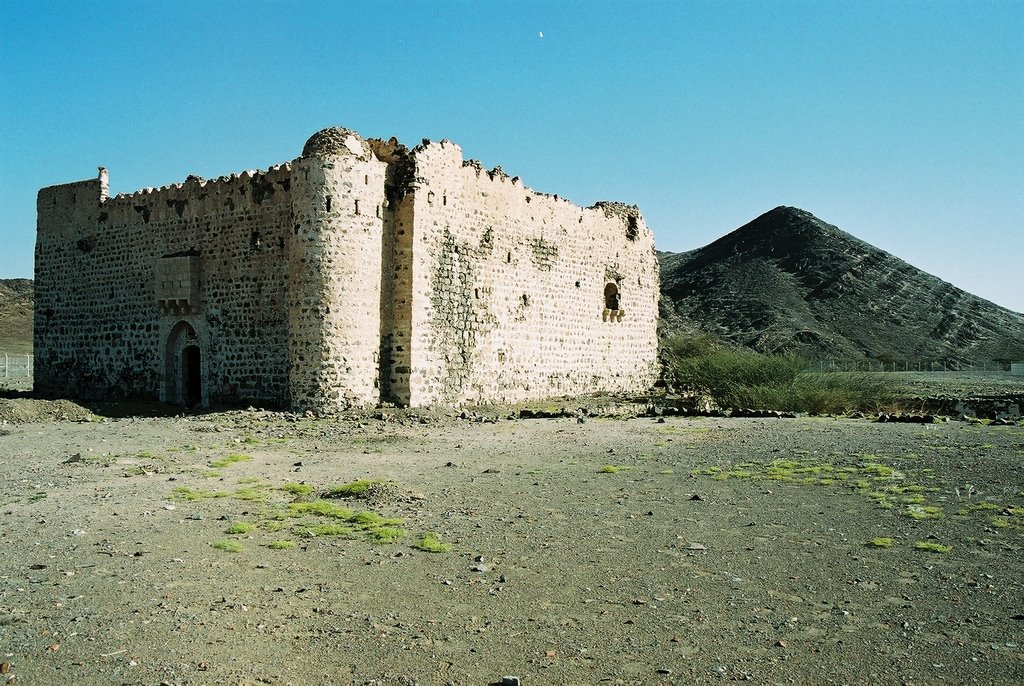 'Every fort is like a prison': an old pilgrim hostel in the Hijaz, Saudi Arabia
News that two British Muslim pilgrims have died in a coach crash while driving between Medina and Mecca is a sad reminder that even today the Muslim pilgrimage, the Hajj, continues to have its dangers. But these are slight compared to the risks one hundred years ago, before the train and plane made getting to the Hijaz to fulfil this once-in-a-lifetime demand of Islam very much more easy.
On her visit to Syria in 1905 the British traveller Gertrude Bell asked her guide about the hardships pilgrims faced on their way to Mecca. 'By the face of God! they suffer,' he answered: 'Ten marches from Maan [in sourthern Jordan] to Medain Salih, then from there to Medina and ten from Medina to Mecca, and the last ten are the worst, for the Sharif of Mecca and the Arab tribes plot together, and the Arabs rob the pilgrims and share the booty with the Sharif. Nor are the marches like the marches of gentlefolk when they travel, for sometimes there are fifteen hours between water and water, and sometimes twenty, and the last march into Mecca is thirty hours.' And he was less than complementary about the fortified caravanserai, or hostels, at which the pilgrims stayed along the route. 'Every fort is like a prison', he said. (The Desert and the Sown, New York 1907, p.239)
Saturday, December 09, 2006
Britain loses major ally in Helmand
The Times reports that the Governor of Helmand, Mohammed Daoud, has been sacked by President Karzai. The reasons for his dismissal are far from clear.
Engineer Daoud was appointed with strong British backing in January. He is seen as honest and not involved in drugs in a part of the world where both qualities are unusual commodities. He was also an outsider with no close link to any of the local tribes. Until a replacement is found the acting governor will be Daoud's deputy, Amir Muhammad Akhunzada, who could not be more different. One source quoted in The Times said: 'For the moment and before a new governor is named, the governor of Helmand is a drug-dealing warlord who was banned from the elections by the UN for keeping a militia and his connection to narcotics, and with whom the British have said they cannot work. Nice.'
Daoud had backed efforts to eradicate next year's poppy crop which is likely to equal or exceed this year's record-breaker, and the decision to remove him raises some awkward questions about President Karzai's priorities. Moreover, will the local peace agreements which Daoud negotiated hold?
Friday, December 08, 2006
Spot the difference
Some revealing semantics at the Bush-Blair press conference yesterday.
George Bush: 'I also believe we're going to succeed. I believe we'll prevail. Not only do I know how important it is to prevail, I believe we will prevail.'
Tony Blair: 'I am sure that it is possible to resolve this [the situation in Iraq] and I also do believe that if we do, then it would send a signal of massive symbolic power across the world.' [My emphasis]
'If' and 'would', Prime Minister? Surely 'When' and 'will'?
Thursday, December 07, 2006
Too late
A lot has already been written on the Iraq Study Group's thoughtful report, published yesterday. The report is an honest appreciation of the crisis in Iraq made all the more stark by the contrast of its tone and depth with the hallucinatory quality of previous statements on the prospects for Iraq made by politicians on both sides of the Atlantic.
Yet the report still has a slightly otherworldly feel to it. Its recommendations - external diplomatic initiatives designed to involve neighbouring countries which have a significant stake in Iraq's future, and internal efforts to achieve national reconciliation - all sound sensible yet still imply that the United States and legislation can play a role which events so far simply do not support. I cannot see Iran and Syria sitting down around a table at a meeting organised by the US government. The easiest way to persuade Iran and Syria to engage themselves would be for the US to withdraw, yet the report rules out this drastic option. After Recommendation 23 the report sets out a series of milestones involving legislation to achieve, for example, amnesties and Iraqi control of its army by the end of next year. And yet earlier, the report clearly states that the army is already divided along regional (and therefore probably sectarian) lines and that the government has favoured Shia over Sunni areas. If that is the consequence of democracy, it is hard to see how any legislation enacted within the Baghdad green zone will have any tangible effect beyond it. With the violence increasing every week and the country's institutions corrupted seemingly beyond repair, I suspect that the report's suggestions have simply come too late.
Tuesday, December 05, 2006
Hezbollah's ancestors?
I'm currently revising my book for the U.S. edition which will be published by WW Norton during next year.
I'm at the stage where Lawrence sets out on a long, behind-the-lines trek into Syria and Lebanon in June 1917. During this mission, he stopped in the Bekaa valley in what is now Lebanon to dynamite a railway bridge. ‘The noise of dynamite explosions we find everywhere the most effective propagandist measure possible’, he wrote afterwards., for the demolitions apparently triggered a revolt by the local Metawala tribesmen. Whether Lawrence did what he claimed has been disputed since: intelligence reports from both the British and the French of an uprising in the area are the strongest evidence there is that he was telling the truth.
The Shiite Metawala were concentrated in southern Lebanon. They were, according to Gertrude Bell ‘an unorthodox sect of Islam’ which had ‘a very special reputation for fanaticism and ignorance’ (The Desert and the Sown, New York 1907, p.160.) I can find little evidence of them today, save for the fact that a village in northern Israel, which was at the centre of the war earlier this summer, is named Metulla. Is there a connection, I wonder. And are the Metawala the ancestors of the modern Hezbollah?
Saturday, December 02, 2006
Whatever happened to the Popular Front?
Seth Wikas of the Washington Institute has produced a handy short guide to the various opposition groups in Syria that the US government is now apparently talking to. It is not an appetising menu.
The Iraq Study Group, whose report is imminent, is expected to advocate engagement with both the Syrian and Iranian regimes. However, the Bush administration's combined output on these countries - labelling Iran as part of the axis of evil and Syria as an associate member - will make it hard for President Bush to accept this approach without implicitly acknowledging that his foreign policy since 9/11 has been a disaster.
The alternative, then, is engagement with the opposition groups in Syria and the exiled Syrian diaspora. If memories are too short in the US administration to remember the outcome of this approach in Iraq (where they backed Ahmed Chalabi) they might sit down one evening and watch the hilarious People's Front of Judea exchange in the Life of Brian which ends with Francis asking "Whatever happened to the Popular Front, Reg?" Reg: "He's over there." Chorus: "SPLITTER!"
Friday, December 01, 2006
Look who's adopting guerrilla tactics in Afghanistan
Reuters has a fascinating report today. It shows how the British have learned from the earlier months of their deployment to Helmand, Afghanistan, by adopting guerrilla tactics to target the Taliban along the fertile Helmand river. Previously the Taliban had taken advantage of the fact that the British were obliged to defend a small number of widely spaced 'platoon houses' in the major towns of northern Helmand. Although it is an implicit acknowledgement that the British forces in southern Afghanistan are overstretched, the Royal Marines' approach may turn the tables.
Wednesday, November 29, 2006
Don't buy a goat this Christmas
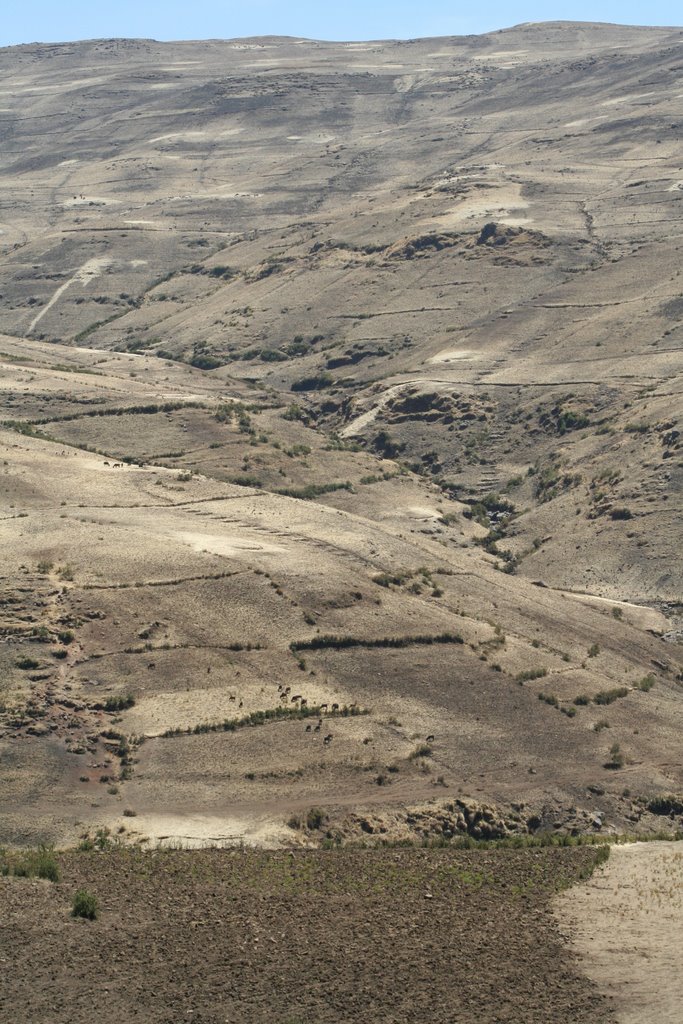 What overgrazing does: the Simien Mountains, northern Ethiopia
'Buy a goat and provide improved nutrition and income generation for a family in Niger or Malawi' - UNICEF. 'Goats: packed full of nourishing delicious milk' - Action Aid. 'These loveable animals are not only an essential source of nutritious milk for an African family, but thanks to a revolving goat project families can breed them to generate income to pay for their child's education - and release themselves from poverty forever' - Practical Action. Goats were Oxfam's biggest seller last year. Everyone wants you to buy a goat this Christmas.
Sounds great doesn't it? Work off your Christmas guilt and hangover by buying a goat for a poor family in Africa or the Middle East. A goat which reproduces, creating yet more goats. But it's a mad idea.
Earlier this year I went to Ethiopia. I was astonished one day to see a goat that had managed to climb a tree, which already looked like wicker. It was eating the last green shoots. Goats eat everything. They turn pasture into desert. In the Simien Mountains, where I was, the earth is like brown talcum powder which blows away when you tread on it. Oxfam, in its defence, says that it 'only provides livestock to communities where livestock keeping is an essential or traditional way of life, and appropriate to the local environment.' But 'It's Traditional' is second-rate thinking. Traditions die out when the people who follow them die out: you only have to look at Easter Island for proof of that, where the people cut down the trees to make logs to roll the statues into place. Charities don't exist to support tradition, because tradition isn't always best. They are there to change and improve.
The charities offer other gifts. Sanitation is still the greatest problem in the third world, though pit lavatories are not fluffy or 'loveable' (a laughable idea for anyone who has watched an Arab thwacking a donkey with a stick). Just please don't buy a goat.
Monday, November 27, 2006
Why are we in Mesopotamia?
Listening to the British Defence Secretary Des Browne's comment today that "I can tell you that by the end of next year I expect numbers of British forces in Iraq to be significantly lower by a matter of thousands", reminded me of the words of an earlier politician. He wrote on 1st January 1921 how "I feel some misgivings about the political consequence to myself of taking on my shoulders the burden and the odium of the Mesopotamia entanglement". If you haven't already guessed, or recognised the quote, it was the highly ambitious Winston Churchill. He had just been appointed Secretary of State for the Colonies, with responsibility for the Middle East. Worried his reputation might be irrevocably damaged by the problems he had been asked to deal with, he would spend the next three months desperately searching for a way to cut Britain's military commitment in Iraq. It looks like Des Browne is doing much the same thing - spurred, I suspect, by the chastening mid-term election results in the United States.
In 1921 Britain ran Mesopotamia, as it then was, as a result of its determination to protect its oil fields in southern Persia during the First World War. In a classic example of mission creep, this defence had ended with the British capturing Baghdad in 1917. As more oil was discovered and its importance in powering the Royal Navy was recognised, they were reluctant to give up their new possession. But the post-war administration of the country, which largely excluded local Arabs, was inept. "I regard the situation in Mesopotamia as disquieting, and if we do not mend our ways, will expect revolt there about March next", TE Lawrence wrote in September 1919. Eight weeks later than he predicted, in May 1920 violence erupted in Iraq. Lawrence would become perhaps the most vocal critic of the government in the months that followed, arguing that Britain should stand back and allow the Arabs to run the country for themselves. "What is required", he wrote in an article in the Observer, "is a tearing up of what we have done, and beginning again on advisory lines." His position was a popular one. A further, famous article he wrote for the Sunday Times was supported by a leader in the paper which asked: "Why are we in Mesopotamia? Uninformative statements which have been issued by the Government convey the impression that officialdom is bewildered and anxious rather to conceal its blunders than to mend them. But they can be concealed no longer…"
"We have not got a single friend in the press upon the subject", Churchill wrote about the crisis in Iraq in 1920. He regretted “pouring armies and treasure into these thankless deserts”. When he was then given the task of tearing up past policy, it was a unpalatable job which has a familiar ring today.
Thursday, November 23, 2006
Syria's alliance with Iran
Just how solid is Syria’s alliance with Iran – the partnership that Britain and the United States are now seemingly trying to break up? In my view, not very.
What unites Syria with Iran is its concern about the threat posed by their common neighbour, Iraq, the country carved from the Ottoman Empire by Winston Churchill and TE Lawrence in 1921. Iraq was made the shape it is to connect the northern oil fields around Mosul with the Gulf port of Basra in the south, and to stop the French (who then ran Syria) from meddling in the Arabian peninsula: hence Iraq's western border with Jordan ensures that Syria and Saudi Arabia do not touch. But, thus defined, Iraq combined a highly combustible mix of religious and ethnic groups which has proved a nightmare for its rulers ever since. The first, the British-backed King Feisal, complained twelve years after he was crowned that ‘There is still – and I say this with a heart of sorrow – no Iraqi people but unimaginable masses of human beings, devoid of any patriotic idea, imbued with religious traditions and absurdities connected by no common tie, giving ear to evil, prone to anarchy and perpetually ready to rise against any government whatever.’
Worried about relying on Iraq for oil, in 1982 Syria negotiated an oil-for-phosphates deal with Iran and then, with its energy supplies assured, cut its ties with Iraq. But Syria and Iran are very different: Syria is a secular dictatorship in which religious fundamentalism has been brutally crushed; Iran a theocracy with ambitions to reclaim a broad swathe of the Middle East, including parts of Iraq and Afghanistan, which it sees as historically Iranian. The population of Syria is largely Sunni, though significant to understanding the regime’s commitment to religious tolerance is the fact that the President, Bashar Assad, comes from the tiny Alawite minority. The people of Iran on the other hand, are mainly Shia. Each country has secretly backed its co-religionists in Iraq, so that Sunni and Shia are now engaged in a ferocious civil war against each other. It is an odd way for two supposed allies to behave.
Iran’s motives for supporting the Iraqi Shias were probably territorial: it would like to extend Iran westwards to the bank of the river Tigris. Syria’s motivation in backing the Sunnis was rather different. Thrown in with Iran and North Korea as an associate member of the 'Axis of Evil' from mid-2002, and fearing it might be next on the United States’ list of targets, Syria armed the Sunnis in Iraq to bog the American invasion down. To understand the Syrians' concerns, it is worth recalling Lawrence's opinion that Syria is 'a country peculiarly and historically indefensible against attack from the east'.
Viewed cold-heartedly, the Syrian policy has been a short-term success. More coalition troops have died in Iraq's western Anbar province, which borders Syria, than in any other part of Iraq and the Americans’ enthusiasm to take on Syria next has now evaporated. But when the coalition leaves, Syria's proxy war becomes a highly dangerous policy, for the Syrian border with Iraq is very porous and the violence in Baghdad is closer than Damascus would like. And the sectarian violence that will probably engulf Iraq following a US withdrawal will pit Syria directly against its supposed ally, Iran. Meanwhile, Iran's claim that it will use its nuclear weapons against Israel, which would surely leave Jerusalem, a holy Muslim city, uninhabitable sits oddly with its attempt to orchestrate anti-western opinion throughout the mostly Sunni Islamic world.
It is the realisation that a precipitate American and British withdrawal from Iraq would leave them in a confrontation with the Iranians that is encouraging the Syrians to reconsider their support for the insurgents. This helps explain the Syrian Foreign Minister Walid al-Moualem’s visit to Baghdad last week, and the reopening of diplomatic ties between the two countries for the first time since 1982. While he was in Baghdad, Moualem signed an agreement agreeing that American troops should remain in Iraq. And that shows just how vulnerable the Syrian position is.
Wednesday, November 22, 2006
Wild pigs
It's frequently said about Spain - where I've just spent a few days - that it is still possible to see the Moorish legacy on the country, more than five hundred years after the Muslim King of Granada finally surrendered to Ferdinand and Isabella on 2 January 1492, completing the reconquista. That influence is obvious in the architecture and, as I discovered while perusing a menu, in the language of the food.
As anyone who has visited will know, the Spanish are mad about ham. There are dozens of types: cured for different lengths of time, with different smoke, and so on. But what caught my eye was the Spanish word for wild pig, which is 'Jabali'. It is a word which rang a bell from my travels in the Middle East on the trail of TE Lawrence, for Jabal in Arabic means mountain. Devout Muslims do not eat ham today: but I wonder whether that was always the case in Spain?
Wednesday, November 15, 2006
Al Jazeera goes live in English
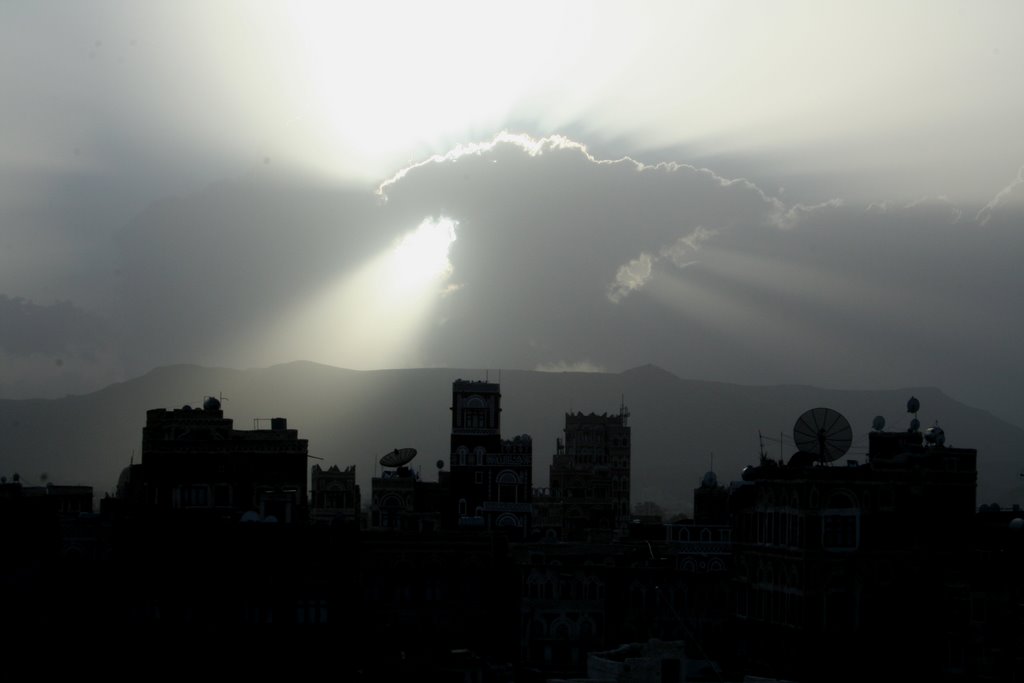 The skyline of the old city of Sanaa, Yemen
The infamous Arabic satellite news channel, Al Jazeera, launched its English language service today to an estimated 80 million homes around the world. Its aim, its director-general says, is to try to reverse the flow of information which currently runs from north to south. It will be interesting to see what effect it has on other broadcasters’ coverage of international news.
Like the BBC, Al Jazeera – ‘The Island’ in Arabic – has made a virtue of its impartiality. As anyone who has visited the Arab world will know, the enormous, rusty satellite dishes on almost every roof testify to a yearning everywhere for independent news which is not satisfied by the turgid daily gobbets from government news outlets. See this scintillating item from the official Syrian news agency, SANA, today if you remain to be convinced.
As the BBC cuts back its short wave radio World Service – and weirdly hopes that its audience around the world can tune in via the internet – there may well be space for Al Jazeera. But whether it can cover the world as it claims it wants to “from the south”, will all boil down to budget. I saw Jon Snow, the journalist and Channel 4 News anchor, speak last year on just this subject, and he reminded the audience that it is far cheaper to broadcast live from the USA than it is to commission a report from Darfur, say, in western Sudan, where there is a genocide going largely unreported. The worst example of the consequences of this, the one that made my blood boil, was the way in which the BBC devoted an entire half-hour evening news bulletin to the verdicts in the Michael Jackson trial in June last year.
Perhaps Al Jazeera will force the BBC to follow more expensive foreign stories. I hope so. But in these cash-strapped times, the frequently trivial rubbish breaking in the developed world looks likely to continue to trump those genuine news stories emerging from the more dangerous and remote elsewhere.
Monday, November 13, 2006
The struggle over Siachen
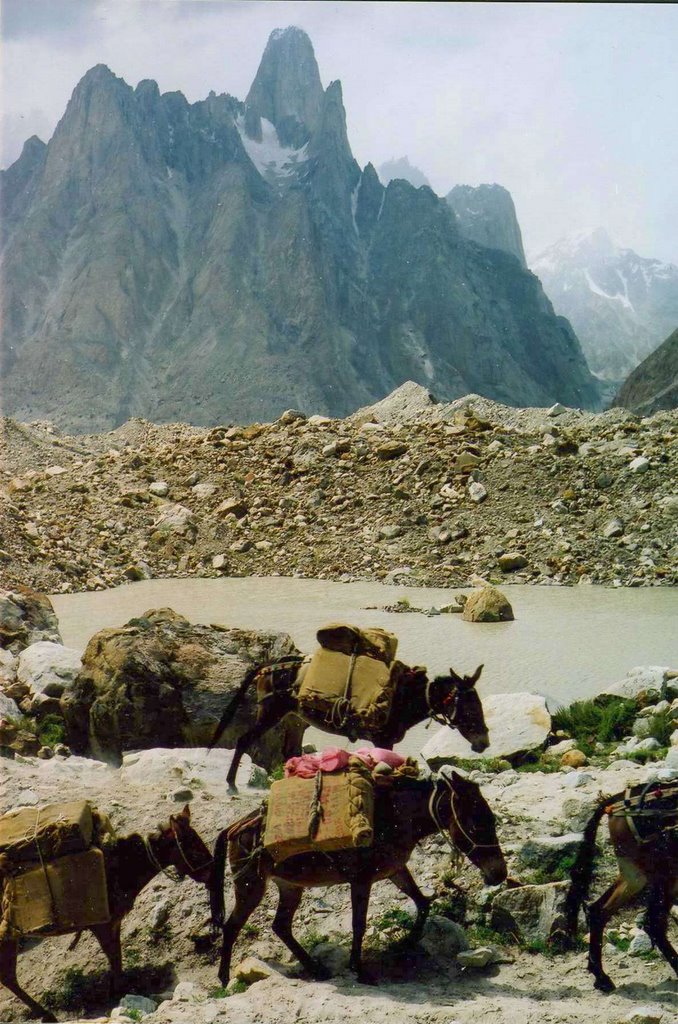
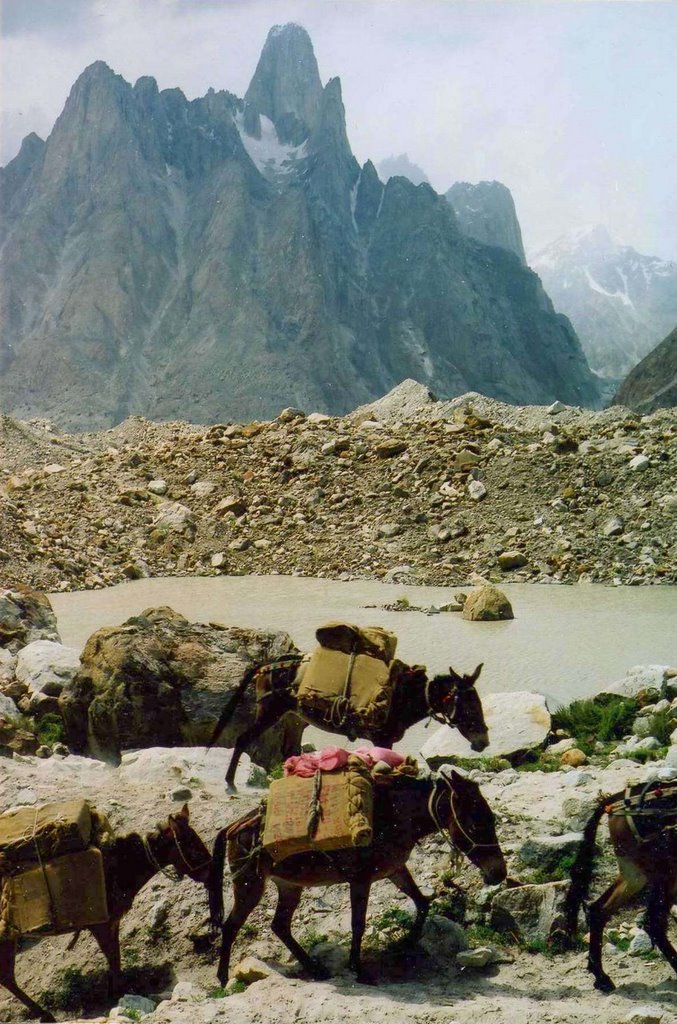 Mules en route to supply the Pakistani front line on Siachen
 Wednesday, November 08, 2006
Saddam the martyr?
I've spent the last few days pondering what impact hanging Saddam Hussein will have. It looks highly unlikely to curb the mounting violence in Iraq. The authorities there (if such a word applies amid such anarchy) feared his death sentence would have the opposite effect. The Shia, for whom Iraqi television is evidently much too dull, want the execution broadcast live. Will it, as some worry, create a martyr? I suspect not, though it is posterity, rather than the executioner, that determines martyrdom.
The most famous Arab martyrs are commemorated in the present names of two public squares in Beirut and Damascus. In 1916 they were known, respectively, as the Burj and the Marjeh. Today, for the events of 6 May that year, both are known as Martyrs' Square. The men hanged there in public early on that date had been sentenced to death for treason against the ruling Ottoman regime. Their crime was to have asked the French for assistance with their cause, and it was the letters they naively sent the French consul which were found when he abandoned his office in 1914 that condemned them. They represented an increasingly self-confident Arab intelligentsia: besides an army officer, a newspaper proprietor, magistrate, barrister, and several local politicians were executed. They were successful people, frustrated by the Arabs' second class status within the Ottoman Empire at that time. One of them died calling on 'the civilised nations of the world' to help them achieve 'our independence and freedom'.
Men less like Saddam you would find it hard to find.
Friday, November 03, 2006
2007 poppy harvest may match record
Next year's opium harvest in Afghanistan may match this year's record levels, Associated Press quotes an anonymous US official predicting. This crop this year was an estimated 6,000 tonnes, producing 600 tonnes of heroin. The planting of next year's crop has now begun.
The official directly linked the size of the harvest with Afghan government's loss of control of the southern provinces of the country, where opium poppy is mainly grown. "We've actually lost a lot of governance in a number of districts in Kandahar, Helmand, and Uruzgan, where the government isn't flying the flag," the official said. "You've got Taliban there that are more in control than the government."
When it is harvested next spring, the size of next year's crop compared to this year's will be a clear indicator of whether NATO is succeeding in bringing greater stability to Afghanistan.
Thursday, November 02, 2006
Boris recants
You can see a perfect example of the sea-change I wrote about two days ago from the brilliant commentator and Conservative MP Boris Johnson in today's Daily Telegraph. Johnson is the shambolic-looking but razor-brained voice of the Telegraph and I would be willing to bet that more readers buy the paper for his Thursday column than for any other single reason (except, probably, the cartoonist Matt). Here he is today completing a u-turn on Iraq:
"It is now commonplace for people like me, who supported the war, to say that we "did the right thing" but that it had mysteriously "turned out wrong". This is intellectually vacuous. It is like saying British strategy for July 1, 1916 was perfect, but let down by faulty execution. The thing was a disaster from the moment we invaded, and it wasn't poor old Rumsfeld's fault for failing to send in enough troops, or failing to do more "planning" for the post-war. No quantity of troops could have prevented this catastrophe; and the dreadful thing is that I think Saddam knew it."
"As long as we are there [in Iraq], the terrorists know that they can maximise the damage to Bush and Blair by blowing up our troops, and so we incite the very violence we are trying to quell. We need to plan for withdrawal, and we need to understand why, why, why we were so mad as to attack Iraq without working out the consequences."
Wednesday, November 01, 2006
The road to Damascus
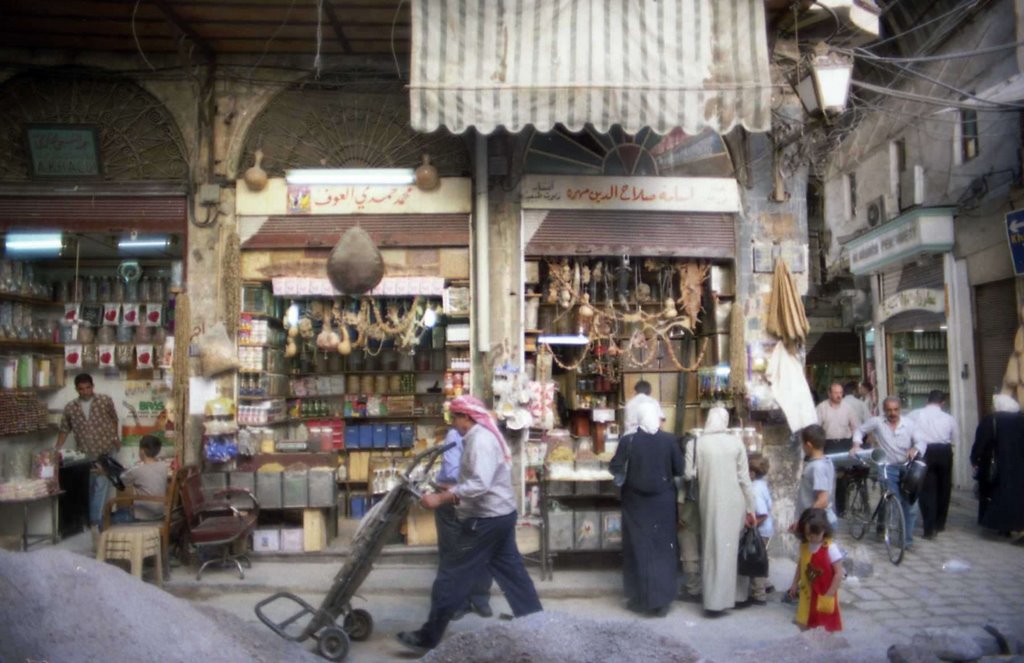 The souk in Damascus
The move comes after British MP Richard Spring's prediction in the Guardian last week that Britain would open talks with the Syrian government.